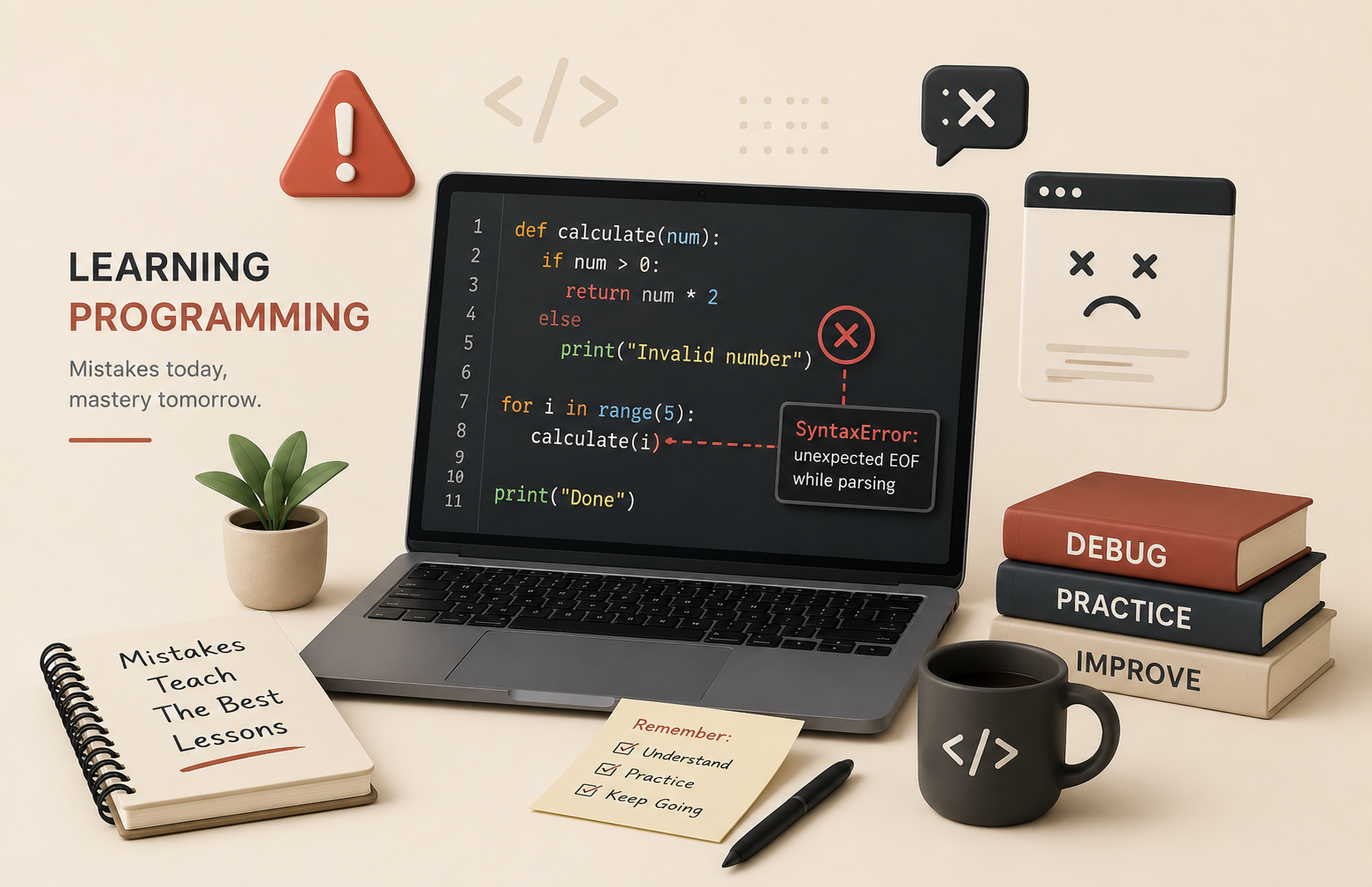
Learning programming has been one of the most rewarding experiences of my academic journey. It opened the door to countless opportunities, from building projects and solving problems to understanding how modern technology works behind the scenes. However, the path was not always smooth. Like many beginners, I made several mistakes that slowed down my progress and made learning more difficult than it needed to be.
Looking back, I realize that these mistakes were valuable lessons. They helped me develop better learning habits and a more practical approach to programming. In this article, I want to share the biggest mistakes I made while learning programming and what I learned from each one.
1. Focusing Too Much on Tutorials
One of the first mistakes I made was spending too much time watching tutorials. Whenever I wanted to learn something new, I would search for a video course and start following it from beginning to end.
At first, it felt productive. I was learning new concepts and understanding how things worked. The problem was that I rarely applied what I learned independently. As soon as I finished a tutorial, I often realized that I couldn't build the same project on my own.
This is commonly known as tutorial dependency. Watching someone else write code can create the illusion of progress, but true learning happens when you write code yourself.
What I learned:
* Tutorials should be used as a starting point, not a destination.
* After learning a concept, build something without following instructions.
* Struggling with implementation is part of the learning process.
2. Trying to Learn Everything at Once
Programming offers countless paths. Web development, data analytics, artificial intelligence, cybersecurity, mobile development, cloud computing, and many more.
When I first discovered these fields, I wanted to learn all of them immediately. I would jump from one topic to another without spending enough time mastering any of them.
As a result, I gained superficial knowledge but lacked depth.
Eventually, I learned that focusing on one area at a time leads to much better results. Once you build a strong foundation, exploring additional domains becomes easier.
What I learned:
* Choose one primary learning path.
* Build a solid foundation before switching topics.
* Consistency is more important than speed.
3. Being Afraid to Build Projects
In the beginning, I thought I needed to learn everything before starting a project.
I would tell myself:
"I'll build projects after I finish learning Python."
Then it became:
"I'll start after learning advanced concepts."
And later:
"I need to learn more frameworks first."
The truth is that there is never a perfect time to start.
Projects are where real learning happens. They expose gaps in knowledge and force you to solve practical problems.
Some of my biggest improvements came from working on projects and facing challenges I had never encountered in tutorials.
What I learned:
* Start building earlier than you think you're ready.
* Small projects are better than no projects.
* Every project teaches something valuable.
4. Copy-Pasting Code Without Understanding It
Whenever I encountered an error, my first instinct was often to search online and copy the solution.
While this sometimes solved the immediate problem, it did very little for my understanding.
Programming isn't about collecting code snippets. It's about understanding why a solution works.
Now, before using any solution, I spend time analyzing:
* What caused the issue?
* Why does this fix work?
* Can I explain the solution in simple words?
This habit has significantly improved my problem-solving skills.
What I learned:
* Understand before you implement.
* Read documentation whenever possible.
* Focus on concepts rather than memorizing code.
5. Ignoring Fundamentals
When I discovered exciting technologies such as AI and modern frameworks, I wanted to jump directly into advanced topics.
The problem was that my fundamentals were not strong enough.
Basic concepts such as:
* Variables
* Loops
* Functions
* Data structures
* Object-oriented programming
seemed simple at first, but they form the foundation of everything else.
Whenever I struggled with advanced concepts, I often found that the real issue was a weak understanding of the basics.
What I learned:
* Strong fundamentals make advanced learning easier.
* Revisit basics regularly.
* Never underestimate core concepts.
6. Comparing Myself to Other Developers
This was one of the most discouraging mistakes I made.
I would see developers creating impressive applications, contributing to open-source projects, or sharing achievements online.
Instead of feeling inspired, I sometimes felt behind.
What I eventually realized was that everyone starts somewhere. The developers I admired had likely spent years learning, practicing, and improving.
Comparing my beginning to someone else's experience was unfair and unproductive.
What I learned:
* Focus on personal growth.
* Measure progress against your past self.
* Every expert was once a beginner.
7. Not Reading Documentation
For a long time, I relied entirely on tutorials and videos.
Documentation looked intimidating, so I avoided it.
Eventually, I realized that official documentation often provides the most accurate and up-to-date information available.
Learning to read documentation improved my independence and helped me solve problems more efficiently.
What I learned:
* Documentation is a valuable skill.
* Most answers already exist in official resources.
* Developers who read documentation learn faster.
8. Giving Up Too Quickly When Facing Errors
Programming errors used to frustrate me.
Sometimes I would spend hours trying to fix a bug and feel like I was making no progress.
Over time, I realized that debugging is an essential part of programming.
Experienced developers encounter errors every day. The difference is that they have developed the patience and problem-solving mindset needed to work through them.
What I learned:
* Errors are normal.
* Debugging improves problem-solving skills.
* Persistence often leads to breakthroughs.
9. Learning Without a Goal
At one point, I was learning random topics without a clear objective.
I would watch videos, read articles, and experiment with technologies, but I lacked direction.
Everything changed when I started learning with specific goals in mind.
Examples included:
* Build a portfolio website.
* Create a dashboard.
* Learn a framework for a project.
* Complete a certification.
Having a goal made learning more focused and meaningful.
What I learned:
* Goals provide direction.
* Purpose-driven learning is more effective.
* Projects create natural learning paths.
10. Expecting Fast Results
Perhaps the biggest mistake of all was expecting rapid progress.
Programming is a skill that takes time to develop. There are no shortcuts that replace practice and experience.
In the beginning, I often felt frustrated when concepts didn't click immediately. Looking back, I realize that growth was happening even when I couldn't see it.
Every hour spent learning, practicing, and building contributed to gradual improvement.
What I learned:
* Progress compounds over time.
* Consistency beats intensity.
* Patience is one of the most important skills a programmer can develop.
Final Thoughts
If there is one thing I have learned from my programming journey, it is that mistakes are not setbacks they are part of the process.
Every mistake I made taught me something valuable and helped shape the way I learn today. While I still have much to learn, these experiences have given me a stronger foundation and a more realistic understanding of what it takes to grow as a developer.
For anyone starting their programming journey, remember that confusion, errors, and challenges are completely normal. Focus on learning consistently, building projects, and improving a little every day.
The goal is not to become an expert overnight. The goal is to keep moving forward, one line of code at a time.