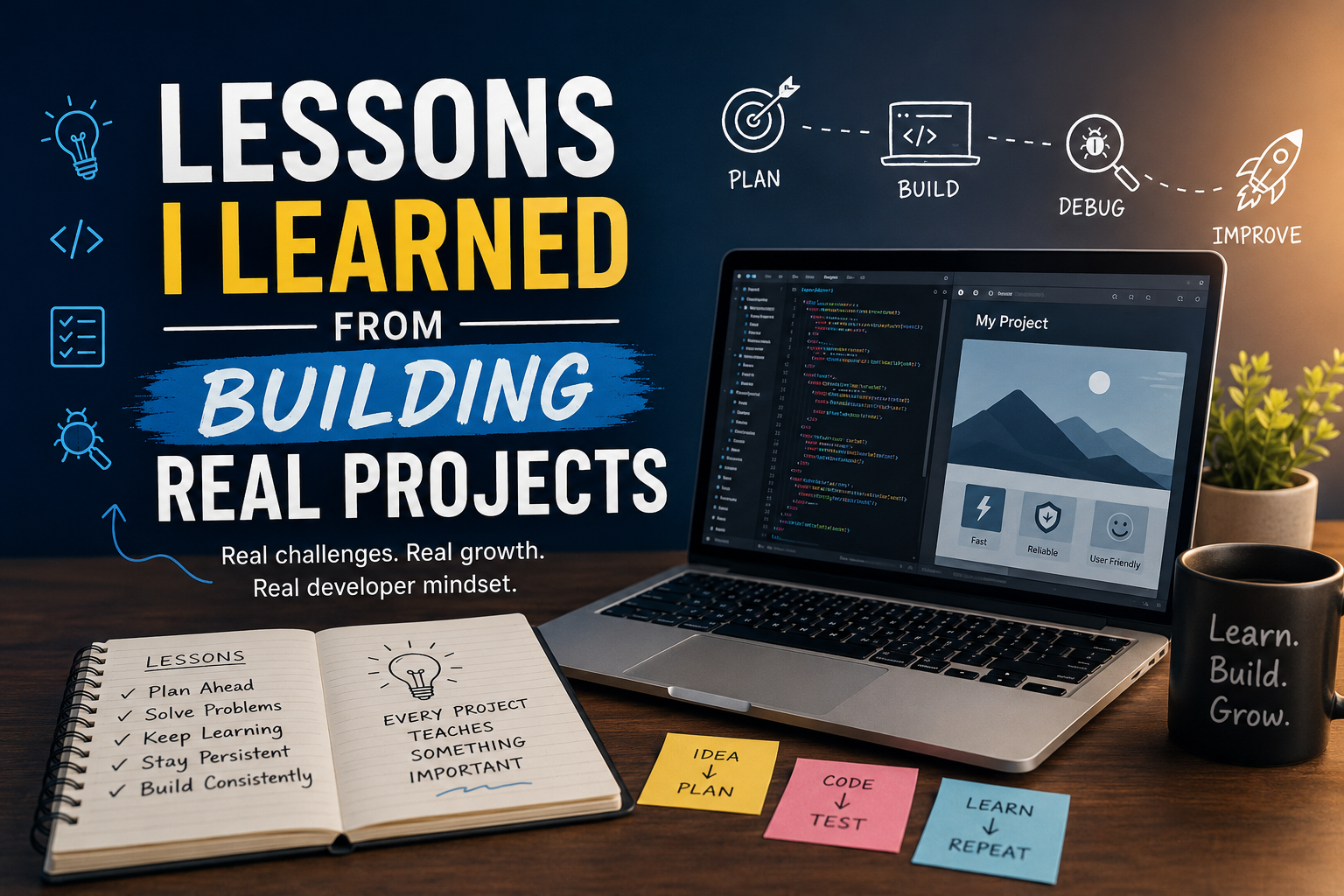
When I first started learning programming, I believed that completing courses and watching tutorials would be enough to become a skilled developer. While those resources helped me understand concepts, I eventually discovered a major difference between learning theory and building real projects.
The real growth happened when I started creating projects.
Projects forced me to apply what I had learned, solve problems independently, and think like a developer instead of a student. Every project introduced new challenges that could not be fully explained through tutorials alone.
Looking back, some of the most valuable lessons in my journey came from building real-world projects. In this article, I want to share the lessons that had the greatest impact on my growth and how they changed my approach to learning technology.
Projects Reveal What You Actually Know
One of the biggest surprises I experienced was realizing how different it feels to build something from scratch.
During tutorials, everything often seems clear.
You watch the instructor write code, explain concepts, and solve problems step by step. It feels like you understand everything.
However, when I started my own projects, I quickly discovered gaps in my knowledge.
Simple questions appeared:
* How should I structure this project?
* Which technology should I use?
* How do I connect different components?
* Why is this feature not working?
Projects exposed weaknesses that tutorials often hide.
Although this was sometimes frustrating, it was also incredibly valuable because it showed me exactly what I needed to improve.
Planning Is More Important Than I Thought
When I built my first projects, I usually started coding immediately.
I was excited to begin and wanted to see results as quickly as possible.
Unfortunately, this approach often created confusion later.
As projects became larger, I realized the importance of planning.
Before writing code, I now spend time thinking about:
* The project's purpose
* Required features
* User experience
* Technology choices
* Potential challenges
Even a simple plan can save hours of unnecessary work.
Good planning creates a clear direction and reduces mistakes during development.
Google Is a Developer's Best Friend
One misconception I had as a beginner was that experienced developers memorize everything.
The reality is very different.
While working on projects, I frequently searched for:
* Error messages
* Documentation
* Best practices
* Technical explanations
* Implementation examples
This helped me understand that programming is not about memorizing information.
It is about knowing how to find information and apply it effectively.
Learning how to research solutions became one of the most important skills I developed.
Debugging Is a Skill
One lesson that every project taught me was the importance of debugging.
No matter how carefully I wrote code, errors always appeared.
Sometimes the problem was obvious.
Other times, I spent hours searching for a tiny mistake.
Initially, debugging felt frustrating.
Over time, however, I realized that debugging is one of the core skills of software development.
Each bug became an opportunity to improve my analytical thinking and problem-solving abilities.
Today, I view debugging as an essential part of the development process rather than an obstacle.
Small Projects Lead to Bigger Projects
In the beginning, I wanted to build large and impressive applications immediately.
I imagined creating advanced platforms without first mastering the basics.
Fortunately, I learned that small projects are powerful learning tools.
Simple projects helped me understand:
* Programming fundamentals
* Application structure
* User interaction
* Problem-solving techniques
Each completed project increased my confidence and prepared me for more complex challenges.
Progress happens step by step.
Small projects create the foundation for larger achievements.
User Experience Matters
One lesson I learned while building applications is that functionality alone is not enough.
A project can work perfectly from a technical perspective and still provide a poor user experience.
Good projects should be:
* Easy to use
* Easy to navigate
* Visually appealing
* Responsive across devices
Thinking about the user's perspective changed the way I approach development.
I became more focused on creating solutions that people actually enjoy using.
Perfection Can Slow Progress
One challenge I faced repeatedly was the desire to make everything perfect.
I would spend excessive amounts of time:
* Adjusting layouts
* Refining designs
* Rewriting code
* Making minor improvements
While quality is important, perfectionism can become a barrier to progress.
Eventually, I learned that completing a project provides more value than endlessly refining it.
Projects can always be improved later.
Finishing and learning from the experience is often the better choice.
Documentation Is More Valuable Than Tutorials
As projects became more complex, I started relying less on tutorials and more on official documentation.
Documentation provided:
* Accurate information
* Updated guidance
* Detailed explanations
* Professional best practices
Initially, reading documentation felt difficult.
With practice, it became one of my most valuable learning resources.
Many problems that seemed complicated were solved simply by reading the official documentation carefully.
Real Projects Build Confidence
One of the most rewarding outcomes of project development is confidence.
Every completed project becomes proof of growth.
Whenever I look back at older projects, I can see how much I have improved.
Projects provide tangible evidence of learning.
This confidence helps motivate future learning and encourages taking on more ambitious challenges.
Projects Teach More Than Technical Skills
Before building projects, I assumed they were primarily about programming.
However, I learned that projects develop many additional skills, including:
Problem Solving
Every project presents unique challenges.
Communication
Explaining a project improves communication abilities.
Research
Finding solutions requires effective research skills.
Time Management
Projects often involve balancing multiple tasks and priorities.
Persistence
Completing projects requires determination and consistency.
These skills are valuable far beyond software development.
Failure Is Part of the Process
Not every project succeeds immediately.
Some ideas did not work as expected.
Some features failed.
Some projects required major revisions.
At first, these setbacks felt discouraging.
Eventually, I realized that failure is an important part of learning.
Every unsuccessful attempt provided lessons that improved future projects.
The goal is not to avoid mistakes.
The goal is to learn from them.
Why Projects Accelerate Learning
After building multiple projects, I have become convinced that projects are one of the most effective learning methods available.
Projects combine:
* Theory
* Practice
* Problem-solving
* Creativity
* Research
into a single experience.
This combination creates deeper understanding than passive learning alone.
Projects transform knowledge into practical skills.
Advice for Students
If you are learning programming, my advice is simple:
Start building projects as early as possible.
Do not wait until you feel fully prepared.
You do not need advanced skills to begin.
Choose a simple idea and start creating.
The project does not need to be perfect.
It only needs to help you learn.
Every project teaches lessons that cannot be learned through tutorials alone.
Final Thoughts
Building real projects has been one of the most valuable parts of my technology journey.
Projects challenged me, frustrated me, taught me, and helped me grow.
They transformed programming from something I studied into something I actively practiced.
More importantly, they taught me that learning is not about memorizing concepts. It is about applying knowledge to solve real problems.
Every completed project represents progress.
Every challenge creates growth.
Every mistake becomes a lesson.
As I continue learning new technologies, I know that projects will remain one of the most important tools in my development journey.
If there is one lesson I would share with any aspiring developer, it is this:
Build more projects.
The experience will teach you far more than you expect.