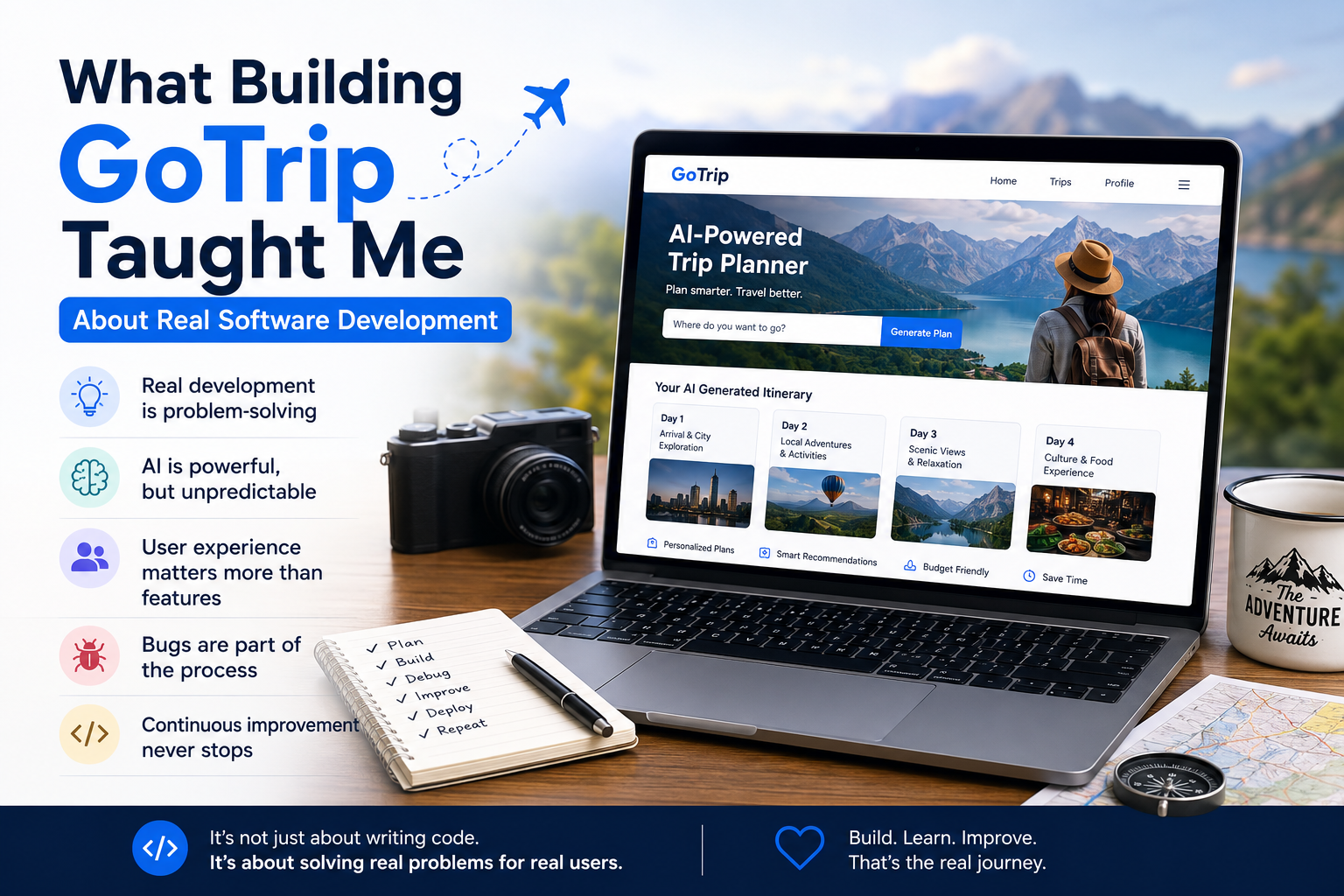
Before I started building GoTrip, I thought software development was mostly about writing code.
If you know the programming language, understand the framework, and can connect a database, you should be able to build almost anything.
At least, that's what I believed.
Then I started working on GoTrip.
What began as an exciting project idea quickly became one of the biggest learning experiences of my journey as a developer.
GoTrip was more than just another project on my resume. It was the first time I experienced what real software development actually feels like.
And it was very different from what tutorials had prepared me for.
The Idea Behind GoTrip
Like many project ideas, GoTrip started with a simple question:
"What if trip planning could be easier?"
Whenever people travel, they spend hours researching destinations, hotels, transportation, budgets, and daily itineraries.
I wondered if AI could help automate that process.
The idea was exciting.
Users would enter their travel preferences, and the application would generate a personalized travel plan.
At that moment, the project sounded straightforward.
Build a website.
Connect an AI model.
Generate itineraries.
Launch.
Done.
Looking back, I had dramatically underestimated how many challenges were waiting ahead.
The Excitement of Starting
The beginning was my favorite part.
Everything felt possible.
I was designing interfaces, planning features, choosing technologies, and imagining how users would interact with the application.
This stage is dangerous because building software looks easy before the first real problem appears.
And real problems always appear.
The First Reality Check
One of the earliest lessons I learned was that software development is mostly problem-solving.
Not coding.
Problem-solving.
The code itself is often the easiest part.
The difficult part is figuring out:
* What should happen when something fails?
* How should users interact with the system?
* What happens if the AI returns bad results?
* How can the application handle unexpected situations?
These questions forced me to think differently.
I stopped asking:
"How do I build this feature?"
And started asking:
"How will this feature behave in the real world?"
That mindset shift changed everything.
Features Are Always Harder Than They Look
One thing I learned very quickly is that every feature seems easy until you start building it.
A feature that sounds simple during planning often expands into multiple smaller problems.
For example:
"Generate an AI travel itinerary."
Sounds straightforward.
But then you realize you need:
* User inputs
* Prompt design
* API integration
* Response validation
* Error handling
* UI presentation
* Loading states
What looked like one feature suddenly becomes ten separate tasks.
This happened repeatedly throughout development.
Every feature taught me to respect complexity.
AI Doesn't Always Behave the Way You Expect
One of the most interesting parts of building GoTrip was working with AI.
Before using AI APIs in a real project, I assumed they would consistently produce reliable outputs.
Reality was different.
Sometimes responses were excellent.
Sometimes they were incomplete.
Sometimes formatting changed unexpectedly.
Sometimes requests failed entirely.
This taught me an important lesson:
Never assume external services will behave perfectly.
Applications need safeguards.
They need validation.
They need fallback mechanisms.
Because users only see your application.
They don't care whether the issue originated from your code or a third-party service.
User Experience Is More Important Than Features
Early in development, I focused heavily on features.
I wanted the application to do more.
More options.
More customization.
More capabilities.
Over time, I realized something surprising.
Users care less about the number of features and more about how easy the application is to use.
A simple feature with excellent user experience often provides more value than a complicated feature nobody understands.
This changed the way I approached design decisions.
Instead of asking:
"What else can I add?"
I started asking:
"How can I make this easier?"
Bugs Are Part of the Process
At the beginning of my programming journey, bugs felt like failures.
GoTrip changed that perspective completely.
When working on a real project, bugs become normal.
You expect them.
Some bugs take minutes to fix.
Others take hours.
A few make you question everything.
I spent countless hours debugging issues that seemed impossible at first.
Yet almost every bug taught me something valuable.
Over time, I stopped fearing bugs.
They became part of the workflow.
Deployment Taught Me Humility
A project running on your local machine is very different from a project running on the internet.
This was another lesson GoTrip taught me.
Everything worked perfectly during development.
Then deployment introduced entirely new challenges.
Configuration issues.
Environment variables.
Build errors.
Hosting limitations.
API restrictions.
Suddenly, there were problems I had never encountered before.
Deployment showed me that software development doesn't end when the code works.
It ends when users can actually use it.
Real Development Is Continuous Improvement
When I started GoTrip, I imagined a finish line.
I thought there would be a moment when the project would finally be "complete."
That moment never arrived.
Every improvement revealed another improvement.
Every feature created new ideas.
Every user interaction suggested new possibilities.
I eventually realized that successful software is rarely finished.
It evolves.
The goal is not perfection.
The goal is continuous improvement.
The Importance of Patience
Perhaps the biggest lesson GoTrip taught me was patience.
There were days when progress felt incredibly slow.
Days when a simple issue consumed hours.
Days when I questioned whether certain features were worth building.
But development is not about daily results.
It's about long-term progress.
A project grows one problem, one solution, and one improvement at a time.
Patience became one of the most valuable skills I developed throughout the process.
What GoTrip Changed About Me
GoTrip didn't just improve my technical skills.
It changed how I think.
Before the project, I focused on learning technologies.
After the project, I focused on solving problems.
Before the project, I wanted to know more tools.
After the project, I wanted to build better solutions.
Before the project, I saw software as code.
After the project, I saw software as a combination of technology, design, user experience, reliability, and continuous improvement.
That shift in perspective was far more valuable than any individual technical skill.
Advice for Students Building Their First Real Project
If you're thinking about building a project, my advice is simple:
Choose something you genuinely care about.
Not because it's trendy.
Not because it looks impressive.
Because you'll spend a lot of time with it.
A meaningful project will keep you motivated when challenges appear.
And challenges will definitely appear.
Start small.
Accept mistakes.
Expect bugs.
Keep improving.
Most importantly, don't wait until you feel ready.
You learn readiness by building.
Final Thoughts
Building GoTrip taught me lessons that no course, tutorial, or certification could have taught.
It showed me the difference between writing code and developing software.
It taught me patience, problem-solving, debugging, design thinking, and continuous improvement.
Most importantly, it taught me that real software development isn't about creating perfect applications.
It's about creating useful solutions, learning from mistakes, and improving with every iteration.
GoTrip is still evolving.
So am I.
And perhaps that's the most valuable lesson of all.