When I first became interested in data analytics, one of the biggest challenges was figuring out where to start. The field seemed vast, with countless tools, technologies, and learning resources available online. I wanted a structured learning path that would help me build a strong foundation instead of randomly jumping between tutorials.
After researching different options, I decided to enroll in the Google Data Analytics Professional Certificate. My goal was not simply to earn another certificate but to understand how data analytics works in real-world situations and develop practical skills that I could apply to projects and future career opportunities.
Now that I have completed the program, I can confidently say that the experience taught me much more than I initially expected. In this article, I want to share what I learned, what surprised me, and how the certificate contributed to my learning journey.
Why I Chose the Google Data Analytics Certificate
There were several reasons why this program stood out to me.
First, it was designed specifically for beginners. Unlike many advanced courses that assume prior knowledge, this certificate starts with the fundamentals and gradually introduces more complex concepts.
Second, the program focuses on practical skills rather than purely theoretical knowledge. Instead of simply explaining concepts, it encourages learners to think like data analysts and solve real-world problems.
Finally, the certificate is offered by Google, a company known for using data-driven decision-making at a massive scale. This gave me confidence that the curriculum would be relevant to industry practices.
My Expectations Before Starting
Before beginning the program, I had a few assumptions about data analytics.
I thought most of the work would involve:
* Creating charts
* Building dashboards
* Working with spreadsheets
* Generating reports
While those tasks are certainly part of analytics, I soon realized that there is much more involved.
The course introduced me to the entire analytics process, from asking the right questions to communicating insights effectively.
This broader perspective was one of the first major lessons I learned.
Understanding the Data Analytics Process
One of the most valuable concepts introduced in the certificate was the structured approach analysts use when working with data.
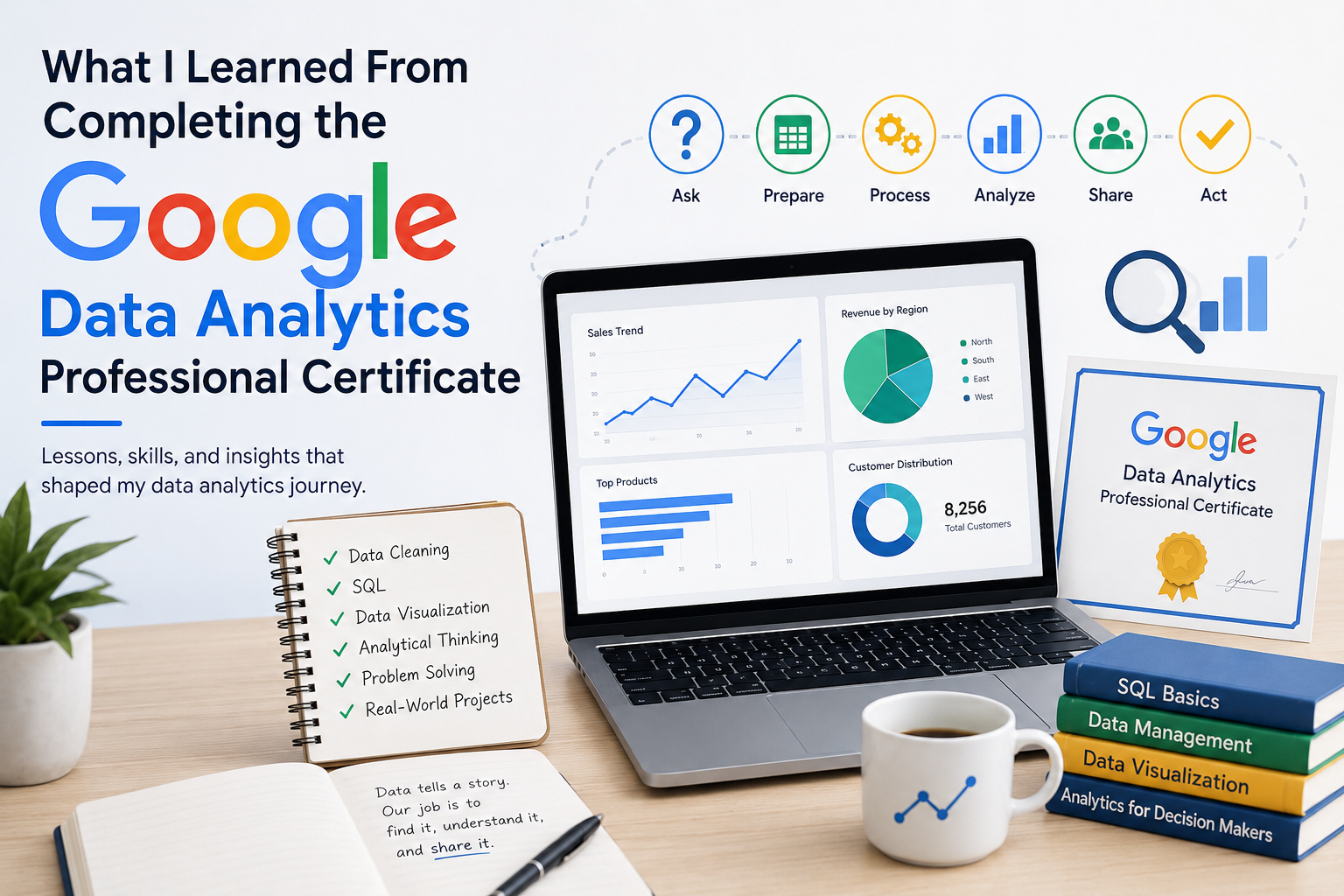
I learned that successful analytics projects typically follow a series of steps:
At first glance, these steps seem straightforward. However, understanding how they connect helped me appreciate how professional analysts approach problem-solving.
Rather than jumping directly into data visualization, analysts first identify the business problem they are trying to solve.
This mindset changed how I think about projects and decision-making.
Data Cleaning Is More Important Than I Expected
Before taking the course, I assumed that most datasets would already be clean and organized.
The reality is very different.
One of the biggest lessons I learned was that real-world data often contains:
* Missing values
* Duplicate records
* Inconsistent formatting
* Incorrect entries
* Unnecessary information
I discovered that a large portion of an analyst's work involves preparing data before analysis can even begin.
Initially, data cleaning seemed repetitive and tedious.
Over time, however, I realized that accurate analysis depends on clean data. Even the most advanced visualizations can become misleading if the underlying data is flawed.
This lesson taught me the importance of attention to detail.
The Importance of Asking Questions
Another concept that stood out to me was the role of curiosity in analytics.
Many beginners focus on tools and technologies.
While tools are important, the course emphasized something even more critical: asking the right questions.
For example:
Instead of asking:
"What does this dataset contain?"
An analyst might ask:
"Why are sales declining in a specific region?"
Or:
"What factors influence customer retention?"
This shift in thinking helps transform data into meaningful insights.
The course helped me understand that analytics is not just about numbers it is about solving problems.
Learning SQL and Data Management
One of my favorite parts of the program was working with SQL.
Before learning SQL, I primarily associated data with spreadsheets.
The course introduced me to databases and showed how organizations manage large amounts of information efficiently.
I learned how to:
* Retrieve data
* Filter records
* Sort information
* Perform calculations
* Combine datasets
SQL quickly became one of the most useful skills I developed.
It also helped me understand how data is stored and accessed in real business environments.
Data Visualization Changed the Way I Communicate Information
Numbers alone can be difficult to interpret.
The certificate demonstrated how effective visualizations can transform complex information into clear and actionable insights.
I learned that good visualizations should:
* Be easy to understand
* Highlight key findings
* Support decision-making
* Avoid unnecessary complexity
This principle applies not only to analytics but also to communication in general.
Whether presenting a dashboard or explaining a project, clarity matters.
Analytical Thinking Is a Skill
One misconception I had before starting the certificate was that analytics was mainly about technical tools.
While technical skills are important, the course repeatedly emphasized analytical thinking.
Analytical thinking involves:
* Breaking down problems
* Identifying patterns
* Evaluating evidence
* Making logical decisions
These skills extend beyond data analytics and are useful in many areas of life.
The more I practiced analytical thinking, the more confident I became in approaching complex problems.
The Value of Hands-On Learning
Another lesson I learned is that practical experience is essential.
Watching tutorials and reading articles can provide knowledge, but applying concepts through projects creates deeper understanding.
The certificate included exercises, case studies, and practical activities that encouraged active learning.
These experiences helped me connect theoretical concepts with real-world applications.
They also reinforced the importance of learning by doing.
Challenges I Faced During the Course
Like any learning experience, the program came with challenges.
Some concepts required additional research and practice before I fully understood them.
There were times when:
* SQL queries became confusing
* Data cleaning felt repetitive
* Analytical concepts seemed overwhelming
However, overcoming these challenges helped strengthen my understanding.
Looking back, the difficult sections often became the most rewarding once everything started to make sense.
How the Certificate Changed My Perspective
Before taking the course, I viewed data primarily as information.
After completing the program, I see data as a powerful tool for decision-making.
Every dataset tells a story.
The role of an analyst is to uncover that story and communicate it effectively.
This perspective has influenced how I approach projects, problem-solving, and even everyday decisions.
Was It Worth It?
In my opinion, yes.
The certificate provided:
* A structured learning path
* Practical skills
* Industry-relevant concepts
* Hands-on experience
* Greater confidence in analytics
While a certificate alone does not guarantee success, the knowledge and skills gained can provide a strong foundation for further learning.
The real value comes from applying what you learn through projects and continuous practice.
Advice for Students Considering the Certificate
If you are thinking about enrolling in the Google Data Analytics Professional Certificate, my advice is simple:
* Focus on understanding concepts rather than rushing through modules.
* Practice SQL regularly.
* Build projects alongside the course.
* Take notes and revisit important topics.
* Be patient with difficult concepts.
The goal should not be collecting certificates.
The goal should be developing skills that you can apply in real-world situations.
Final Thoughts
Completing the Google Data Analytics Professional Certificate was an important milestone in my learning journey.
It introduced me to the complete analytics process, strengthened my technical skills, and helped me develop a more analytical way of thinking.
Most importantly, it showed me that data analytics is not just about working with numbers. It is about solving problems, making informed decisions, and uncovering insights that create value.
While I still have much to learn, this certificate gave me a strong foundation and the confidence to continue exploring the world of data analytics. It reinforced my belief that continuous learning and practical experience are the keys to growth in any technology field.