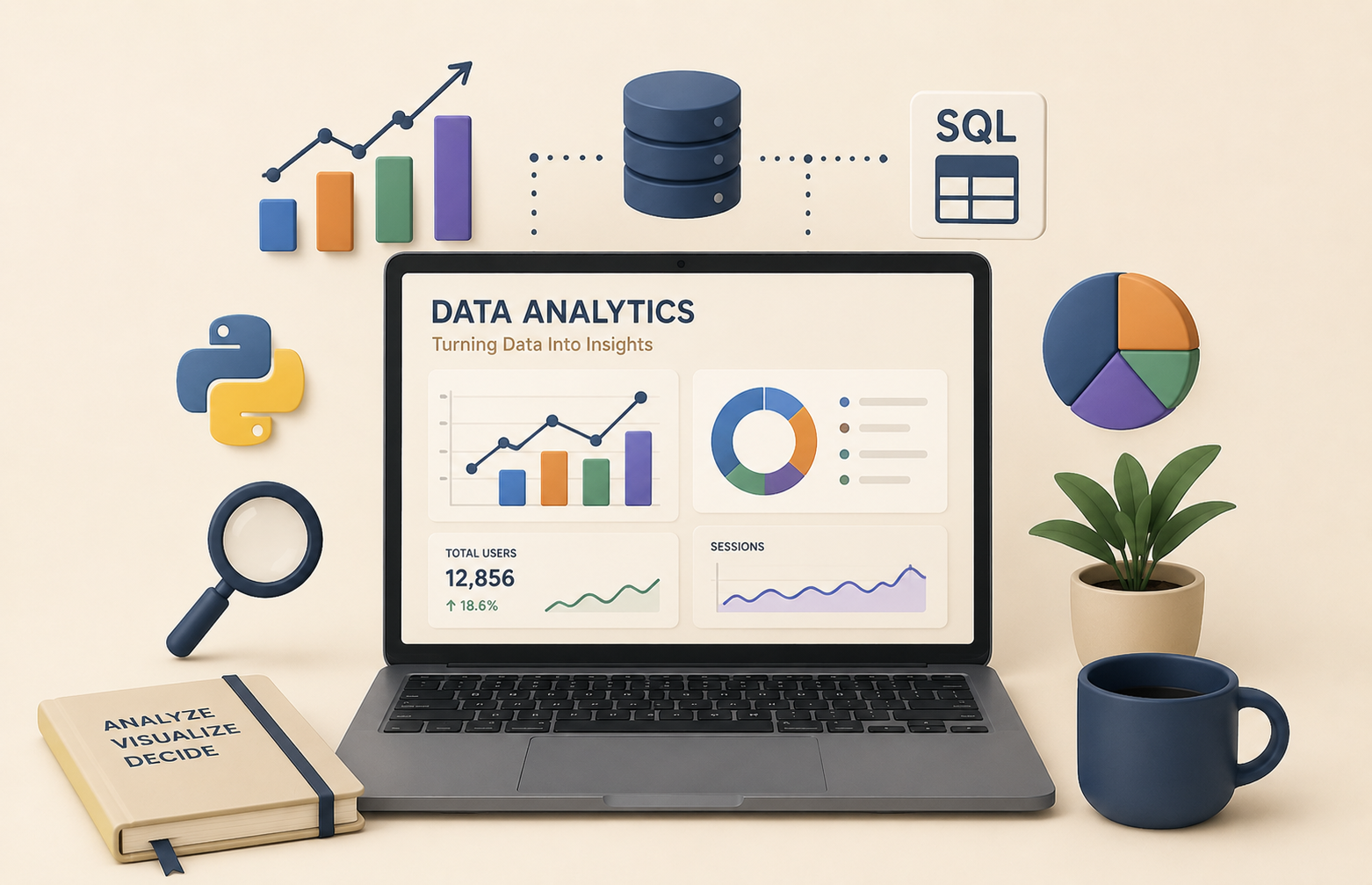
When I first started my Computer Science Engineering journey, I had a general interest in technology, programming, and software development. Like many students, I was exploring different domains and trying to understand which field aligned best with my interests and career goals. During this exploration, I came across Data Analytics, a field that has significantly changed the way I look at information and decision-making.
Initially, I had a very simple understanding of data analytics. I thought it mainly involved creating charts and dashboards from datasets. However, as I started learning more about the field, I realized that data analytics is much more than visualization. It is the process of collecting, cleaning, analyzing, and interpreting data to uncover meaningful insights that can support better decisions.
My interest in data analytics grew when I started noticing how data influences almost every aspect of modern life. Companies use data to understand customer behavior, improve products, optimize operations, and make strategic decisions. Even the recommendations we receive on streaming platforms, shopping websites, and social media applications are heavily influenced by data-driven systems.
The first challenge I faced was understanding where to begin. The field seemed enormous, with countless tools, technologies, and learning paths available. Some resources recommended learning programming first, while others emphasized statistics, visualization tools, or databases. This abundance of information was both exciting and overwhelming.
To create a structured learning path, I decided to focus on the fundamentals. I started by improving my Python skills because Python is widely used in data analytics and data science. Learning Python helped me understand how data can be manipulated, processed, and analyzed efficiently. As I practiced coding, I became more comfortable working with different types of datasets and solving analytical problems.
Alongside Python, I began learning SQL. This was an eye-opening experience because I realized that data is often stored in databases rather than spreadsheets. SQL taught me how to retrieve, filter, aggregate, and analyze information directly from large datasets. Understanding SQL made me appreciate the importance of structured data management and how businesses use databases to support daily operations.
One of the most important lessons I learned early in my journey was that real-world data is rarely perfect. Before learning data analytics, I assumed that datasets would always be clean and ready for analysis. In reality, data often contains missing values, duplicate entries, inconsistent formatting, and various other issues. I discovered that a significant portion of a data analyst's work involves cleaning and preparing data before any meaningful analysis can begin.
As I continued learning, I explored tools such as spreadsheets, Tableau, and Power BI. These tools showed me how data can be transformed into visual stories that are easy to understand. A well-designed dashboard can communicate insights far more effectively than a table filled with numbers. This aspect of data analytics fascinated me because it combines technical skills with creativity and communication.
One of the most valuable steps in my learning journey was working on practical projects. I quickly realized that watching tutorials alone was not enough. Building projects forced me to apply concepts, solve unexpected problems, and think critically about real-world scenarios. Every project taught me something new, whether it was data cleaning techniques, visualization best practices, or analytical thinking.
Another important milestone in my journey was enrolling in professional courses and certifications. Structured learning programs helped me develop a stronger foundation and exposed me to industry-standard practices. They also introduced me to real-world case studies that demonstrated how organizations use data to solve business challenges.
However, the journey was not always smooth. There were times when I felt overwhelmed by the amount of information available. Some concepts took longer to understand than I expected, and there were moments when progress felt slow. Looking back, I realize that these challenges were a normal part of the learning process. Every difficulty helped me strengthen my understanding and improve my problem-solving skills.
One of the biggest misconceptions I had before entering the field was that data analytics was primarily about mathematics. While analytical thinking and basic statistical knowledge are important, I learned that curiosity and problem-solving skills are equally valuable. A successful analyst is not just someone who understands numbers but someone who can ask meaningful questions and extract actionable insights from data.
Today, I see data analytics as more than just a technical skill. It is a way of thinking. It encourages a logical and evidence-based approach to solving problems. Instead of relying on assumptions, data analytics teaches us to make decisions based on facts and measurable outcomes.
As I continue my journey, I plan to deepen my understanding of advanced analytics, machine learning, and artificial intelligence. These fields are closely connected, and I believe they will play an increasingly important role in the future of technology. My goal is not only to learn these technologies but also to use them to create solutions that provide real value.
For students who are considering data analytics, my advice is simple: start with the basics, stay consistent, and focus on building projects. Do not worry about mastering every tool immediately. The field is vast, and learning takes time. Progress may seem slow in the beginning, but every small step contributes to long-term growth.
My journey into data analytics is still ongoing, and there is much more to learn. However, every concept I understand and every project I complete reinforces my belief that I chose the right path. Data analytics has not only expanded my technical skills but also changed the way I approach problems and make decisions. It is a journey that continues to challenge me, motivate me, and inspire me to keep learning.