Artificial Intelligence is one of the most exciting fields in technology today. From virtual assistants and recommendation systems to self-driving cars and advanced chatbots, AI is transforming industries across the world. As a Computer Science student, I have always been fascinated by how machines can learn from data and perform tasks that traditionally required human intelligence.
My interest in AI did not develop overnight. It grew gradually as I explored programming, data analytics, and real-world applications of technology. The more I learned, the more I realized that artificial intelligence combines many of the areas I enjoy most, including problem-solving, programming, data analysis, and innovation.
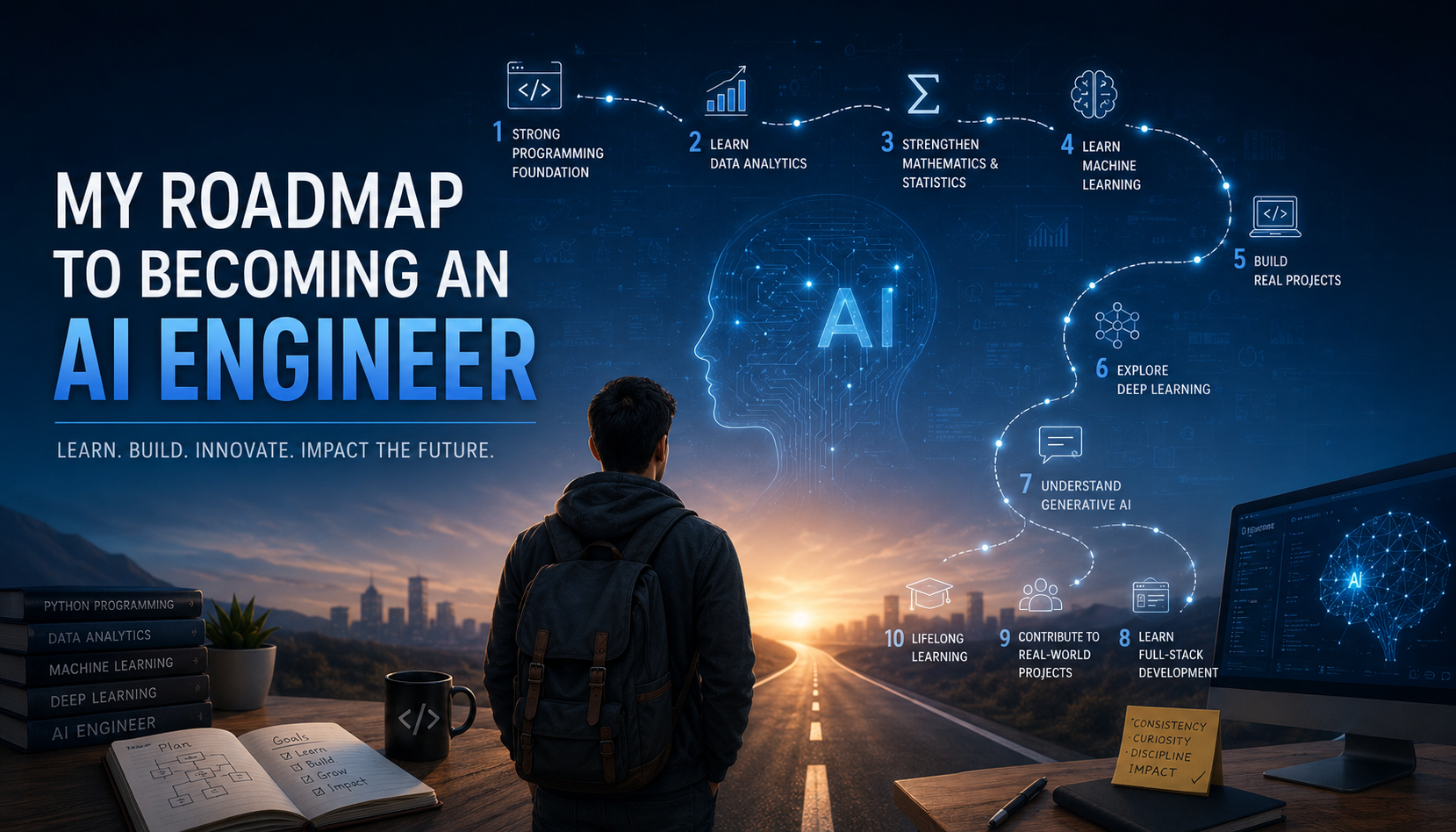
While I am still on my learning journey, I have created a roadmap that guides my progress toward becoming an AI Engineer. This roadmap helps me stay focused, measure my growth, and understand what skills I need to develop in the coming years.
Why I Want to Become an AI Engineer
One of the main reasons I am interested in AI is its ability to solve complex problems.
Artificial intelligence is not just about creating intelligent systems. It is about building solutions that can improve efficiency, automate repetitive tasks, and help people make better decisions.
Whether it is healthcare, education, finance, transportation, or business, AI has the potential to create meaningful impact.
I want to be part of that transformation by developing systems that solve real-world challenges and provide value to users.
Step 1: Building Strong Programming Fundamentals
Before diving into advanced AI concepts, I realized the importance of having a strong programming foundation.
Many beginners focus immediately on machine learning models and AI frameworks. However, without understanding programming fundamentals, learning advanced concepts becomes much more difficult.
My first goal was to strengthen my knowledge of:
* Variables and data types
* Functions
* Loops and conditional statements
* Object-oriented programming
* Data structures
* Algorithms
* Problem-solving techniques
These concepts serve as the building blocks for everything else.
Python became my primary programming language because of its simplicity, versatility, and popularity within the AI community.
Step 2: Learning Data Analytics
As I explored AI, I discovered that data plays a central role in every intelligent system.
AI models learn from data, which means understanding data is essential.
This realization motivated me to study data analytics.
Through data analytics, I learned:
* Data cleaning
* Data visualization
* Data transformation
* Statistical analysis
* SQL
* Dashboard creation
These skills helped me understand how data is collected, processed, and interpreted before it is used in machine learning systems.
In many ways, data analytics became the bridge between programming and artificial intelligence.
Step 3: Strengthening Mathematics and Statistics
One area I initially underestimated was mathematics.
While modern libraries simplify many complex calculations, understanding the underlying principles remains important.
To strengthen my foundation, I focused on:
Statistics
Understanding:
* Mean
* Median
* Mode
* Probability
* Hypothesis testing
* Distributions
Linear Algebra
Learning:
* Matrices
* Vectors
* Matrix operations
Basic Calculus
Understanding:
* Derivatives
* Gradients
* Optimization concepts
Although mathematics can be challenging, it provides valuable insight into how machine learning algorithms function.
Step 4: Learning Machine Learning
Machine Learning is often considered the core of modern AI.
After developing a foundation in programming and data analytics, I began exploring machine learning concepts.
My learning path includes:
Supervised Learning
Models that learn from labeled data.
Examples:
* Classification
* Regression
Unsupervised Learning
Models that identify patterns without labels.
Examples:
* Clustering
* Dimensionality reduction
Model Evaluation
Understanding:
* Accuracy
* Precision
* Recall
* F1 Score
Rather than simply using algorithms, I aim to understand why they work and when they should be applied.
Step 5: Building Real Projects
One lesson I have learned repeatedly is that projects accelerate learning.
Watching tutorials provides information, but building projects develops practical skills.
My roadmap includes creating projects that solve real problems.
Examples include:
* Recommendation systems
* Predictive analytics projects
* AI-powered applications
* Data-driven web applications
Projects help me:
* Apply concepts
* Build confidence
* Improve problem-solving abilities
* Create a portfolio of work
Every project becomes an opportunity to learn something new.
Step 6: Exploring Deep Learning
After gaining confidence in machine learning, my next goal is to dive deeper into deep learning.
Deep learning powers many modern AI applications, including:
* Image recognition
* Natural language processing
* Speech recognition
* Generative AI
Key topics I plan to explore include:
Neural Networks
Understanding how artificial neurons process information.
Convolutional Neural Networks (CNNs)
Used primarily in computer vision tasks.
Recurrent Neural Networks (RNNs)
Designed for sequential data processing.
Transformers
The foundation of many modern language models.
Learning these concepts will help me understand how advanced AI systems are built.
Step 7: Understanding Generative AI
Generative AI has become one of the fastest-growing areas in technology.
From content generation to intelligent assistants, generative models are changing how people interact with technology.
I am particularly interested in learning:
* Large Language Models (LLMs)
* Prompt engineering
* AI agents
* Retrieval-Augmented Generation (RAG)
* AI application development
This area aligns closely with my long-term interests and future project ideas.
Step 8: Learning Full-Stack Development
One insight I gained during my learning journey is that AI models alone are not enough.
To deliver value, AI systems must be integrated into applications that users can interact with.
This is why I continue developing my full-stack development skills.
I aim to learn:
* Frontend development
* Backend development
* APIs
* Databases
* Cloud deployment
Combining AI with software engineering creates opportunities to build complete solutions rather than isolated models.
Step 9: Contributing to Real-World Projects
Learning becomes more meaningful when applied to practical situations.
As I continue growing, I hope to contribute to:
* Open-source projects
* Collaborative development teams
* Industry projects
* Research initiatives
These experiences will expose me to real-world challenges and help me understand how AI is used professionally.
Step 10: Lifelong Learning
Technology evolves rapidly.
New frameworks, tools, and techniques emerge every year.
Because of this, one of the most important parts of my roadmap is maintaining a mindset of continuous learning.
I plan to:
* Read technical articles
* Follow industry developments
* Take relevant courses
* Build projects regularly
* Learn from experienced professionals
The learning process never truly ends.
Challenges I Expect Along the Way
I understand that becoming an AI Engineer is not a short journey.
There will be challenges such as:
* Complex mathematical concepts
* Difficult projects
* Rapidly changing technologies
* Technical failures
* Continuous skill development
However, I view these challenges as opportunities to improve rather than obstacles to avoid.
Every challenge teaches something valuable.
Measuring My Progress
To stay motivated, I focus on measurable goals.
Examples include:
* Completing courses
* Building projects
* Learning new technologies
* Improving coding skills
* Expanding my portfolio
Tracking progress helps me see how far I have come and identify areas that need improvement.
Final Thoughts
My roadmap to becoming an AI Engineer is not a fixed plan but a guide that evolves as I learn and grow.
The journey requires dedication, curiosity, and patience. There is a vast amount of knowledge to acquire, but that is also what makes the field so exciting.
Every project, course, and challenge brings me one step closer to my goal.
While I am still early in my journey, I am excited about the opportunities ahead and motivated to continue learning. Artificial intelligence is shaping the future, and I hope to contribute to that future by building intelligent solutions that make a meaningful impact.
For anyone considering a similar path, my advice is simple: start with the fundamentals, stay consistent, build projects, and never stop learning. Progress may be gradual, but every small step matters.