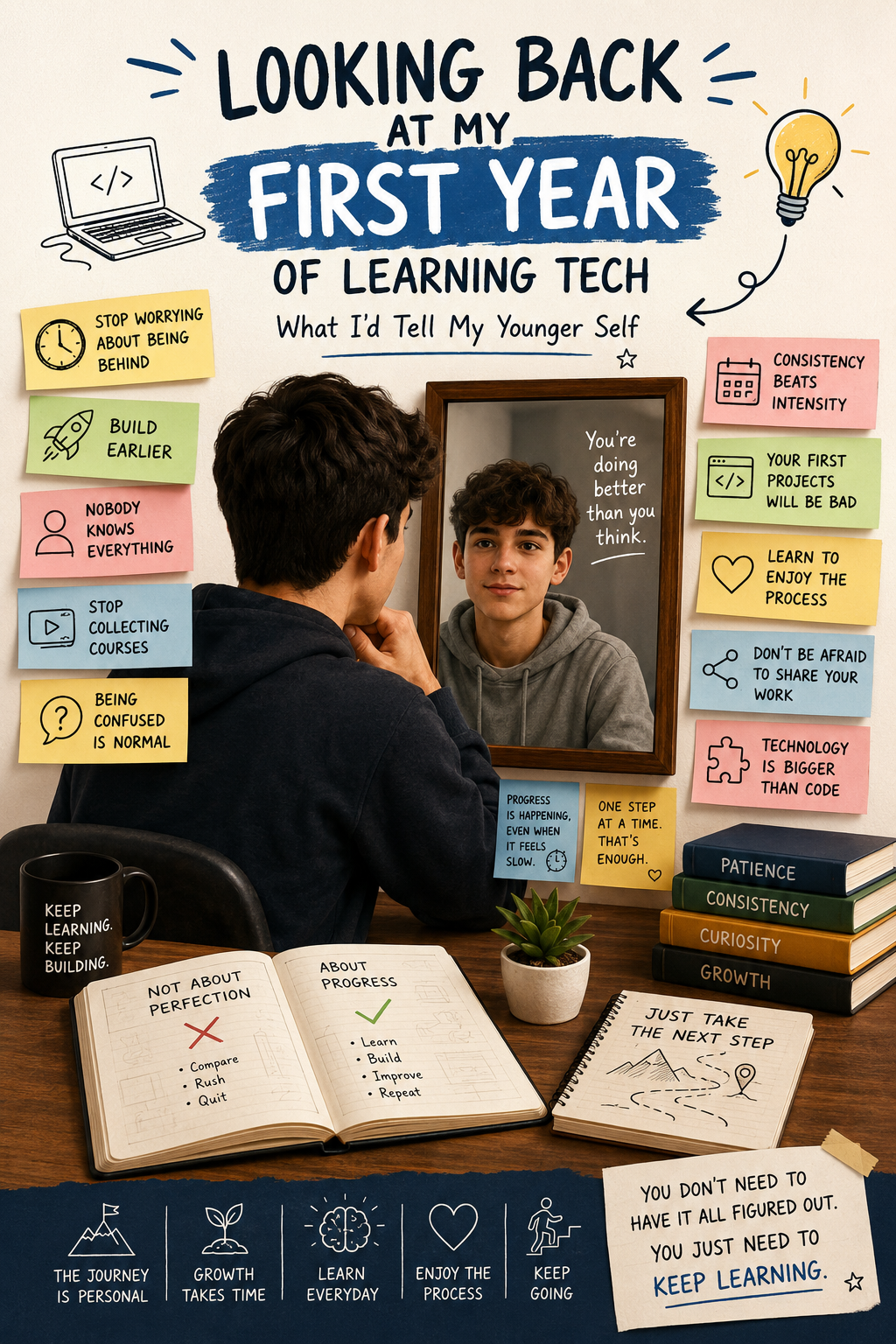
If I had the chance to sit down with the version of myself who was just beginning to learn technology, I'm not sure I would talk about programming languages.
I probably wouldn't explain databases.
I wouldn't discuss frameworks.
And I definitely wouldn't hand over a list of courses to complete.
Instead, I would talk about the things that took me months, and sometimes years, to understand.
The lessons that tutorials rarely teach.
The lessons that only become obvious after making mistakes.
This isn't a guide for beginners.
It's more like a conversation with my younger self.
A collection of things I wish I had understood earlier.
Stop Worrying About Being Behind
One of the biggest mistakes I made was constantly feeling late.
Whenever I opened social media, I saw students building incredible projects.
People my age were sharing internships, certifications, hackathon wins, and impressive portfolios.
It felt like everyone was moving faster than me.
What I didn't realize at the time was that I was only seeing the highlights.
I wasn't seeing the years of effort behind those achievements.
I wasn't seeing the failed projects.
The confusion.
The setbacks.
The countless hours spent learning.
If I could go back, I would tell myself:
Your journey doesn't need to look like anyone else's.
Focus on your own progress.
That's enough.
Build Earlier
I spent far too much time preparing to build.
Learning.
Watching.
Planning.
Researching.
Everything except actually building.
I kept telling myself I needed more knowledge first.
The truth is that projects are where the learning happens.
The moment you start building, everything changes.
You stop consuming information.
You start solving problems.
You stop following instructions.
You start making decisions.
If I could change one thing about my learning journey, I would start building projects much sooner.
Not because the projects would be amazing.
Because the lessons would arrive faster.
Nobody Knows Everything
When I first entered the technology world, I assumed experienced developers had all the answers.
I imagined that one day I would reach a point where everything made sense.
That day never came.
And that's actually a good thing.
The more I learned, the more I realized how much there was still left to learn.
Technology is too large.
Too dynamic.
Too fast-moving.
Nobody knows everything.
And nobody is expected to.
Once I accepted that, learning became much less stressful.
The goal isn't knowing everything.
The goal is becoming better at learning.
Stop Collecting Courses
You don't need another course.
You don't need another roadmap.
You don't need another YouTube playlist.
What you need is application.
For a while, I treated learning like collecting.
Every new course felt productive.
Every certificate felt like progress.
But some of my biggest growth happened when I stopped enrolling and started building.
Courses are valuable.
But they should support projects.
Not replace them.
Being Confused Is Normal
I wish I had understood this earlier.
Some days, learning technology feels easy.
Other days, even simple concepts seem impossible.
There were moments when I questioned whether I was smart enough for certain topics.
Especially when learning things outside my comfort zone.
What I know now is that confusion is not a warning sign.
It's often a growth signal.
If you're confused, it usually means you're learning something new.
That's not failure.
That's progress.
Consistency Beats Intensity
I used to believe success came from massive bursts of productivity.
Study for ten hours.
Finish multiple courses.
Learn everything quickly.
The reality was very different.
Most progress came from ordinary days.
One hour.
Two hours.
A little learning.
A little building.
A little improvement.
Repeated consistently.
The students who improve the most aren't necessarily the ones who work hardest for one week.
They're the ones who keep showing up for months.
And eventually, years.
Your First Projects Will Be Bad
And that's okay.
Actually, it's unavoidable.
Every developer has projects they're slightly embarrassed by.
Projects that looked impressive at the time but seem basic now.
That's not a problem.
That's evidence of growth.
The goal of a first project isn't excellence.
The goal is experience.
The project teaches you something.
Then the next project teaches you something else.
Improvement happens through repetition.
Not perfection.
Learn to Enjoy the Process
This might be the lesson I value most.
For a long time, I focused entirely on outcomes.
The next skill.
The next project.
The next certificate.
The next achievement.
I was always looking ahead.
Always chasing the next milestone.
What I eventually learned is that technology is a lifelong field.
There will always be another goal.
Another framework.
Another opportunity.
If you only enjoy achievements, you'll spend most of your time waiting.
Learning became much more enjoyable when I started appreciating the process itself.
The curiosity.
The experimentation.
The gradual improvement.
That's where most of the journey actually happens.
Don't Be Afraid to Share Your Work
I used to think my projects weren't good enough.
My portfolio wasn't polished enough.
My skills weren't advanced enough.
So I delayed sharing things.
Looking back, that was unnecessary.
Sharing your work creates opportunities.
Feedback.
Connections.
Learning.
Growth.
You don't need to be an expert before showing what you're building.
You just need to be genuine.
Technology Is Bigger Than Code
This took me a long time to understand.
Programming is important.
But technology isn't only about code.
It's about:
* Problem-solving
* Communication
* Design
* Creativity
* Persistence
* Curiosity
Some of the most valuable skills I've developed aren't technical at all.
They're the skills that help me learn, collaborate, and adapt.
The sooner you recognize this, the more balanced your growth becomes.
What I Wouldn't Change
Despite all the mistakes, there are things I wouldn't change.
The failed projects.
The confusion.
The wrong turns.
The periods of uncertainty.
Because each of those experiences taught something valuable.
Without them, I wouldn't have developed the perspective I have today.
Growth rarely follows a straight line.
And that's perfectly normal.
A Final Message to My Younger Self
If I could leave my younger self with one message, it would be this:
Keep going.
The days when you feel stuck won't last forever.
The concepts that seem impossible today will eventually make sense.
The skills you're trying to build will develop over time.
The progress you're struggling to see is happening, even when it feels slow.
You don't need to have everything figured out.
You don't need to know the entire roadmap.
You just need to take the next step.
Then the one after that.
And eventually, you'll look back and realize how far you've come.
Final Thoughts
Looking back at my first year of learning technology, I realize that the most important lessons weren't technical.
They were lessons about patience.
Consistency.
Growth.
And perspective.
Technology taught me how to build software.
But the journey taught me how to keep learning.
And if there's one thing I've learned so far, it's that the ability to keep learning is far more valuable than any single technology you'll ever master.