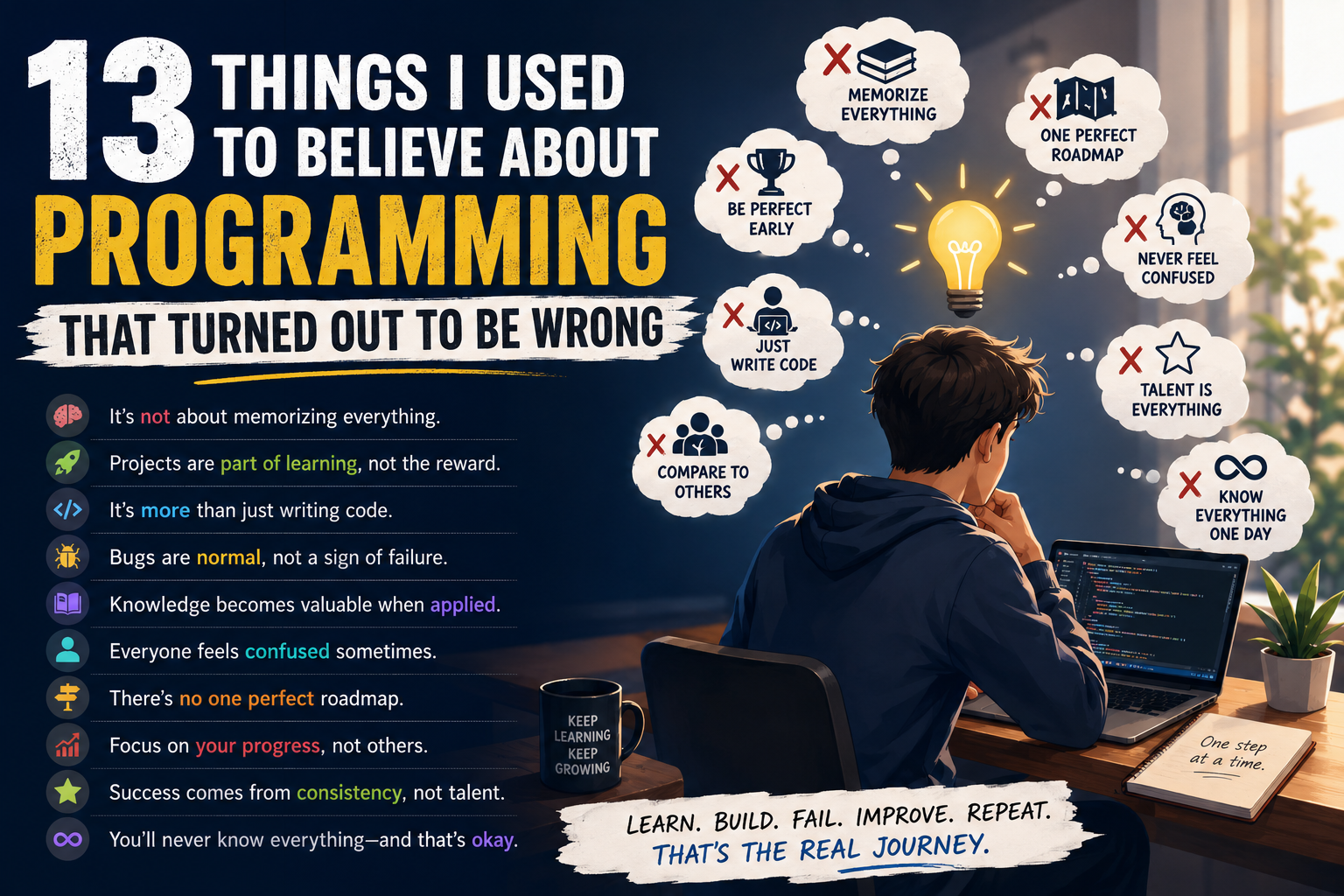
When I first started learning programming, I had a lot of assumptions.
Some came from social media.
Some came from movies.
Some came from watching experienced developers online.
And some were simply conclusions I made because I didn't know any better.
The interesting thing about learning technology is that many of your beliefs get challenged along the way.
The more experience I gained, the more I realized that several things I once believed about programming were completely wrong.
Looking back, these misconceptions slowed my progress, created unnecessary pressure, and sometimes made learning more difficult than it needed to be.
In this article, I want to share some of the biggest misconceptions I had about programming and what I learned after discovering the reality.
1. I Thought Good Programmers Memorized Everything
When I first started coding, I assumed experienced developers had entire programming languages stored in their memory.
I imagined professional developers typing thousands of lines of code without needing any help.
Whenever I forgot syntax or searched for solutions online, I felt like I wasn't learning properly.
Then I noticed something surprising.
Experienced developers search for things all the time.
They read documentation.
They check examples.
They look up syntax.
They research solutions.
The difference isn't that they memorize everything.
The difference is that they know how to find information efficiently.
Programming is not a memory competition.
It's a problem-solving skill.
That realization removed a lot of unnecessary pressure from my learning journey.
2. I Thought I Needed to Learn Everything Before Building Projects
This belief kept me stuck for a long time.
I would tell myself:
"I'll start building projects after I finish learning Python."
Then it became:
"I'll start after learning databases."
Then:
"I'll start after learning frameworks."
There was always another topic I thought I needed to learn first.
The problem was that the finish line kept moving.
Eventually, I realized something important.
Projects are not the reward for learning.
Projects are part of learning.
In fact, some of my biggest learning breakthroughs happened while building projects I wasn't fully prepared for.
If I had waited until I felt ready, I probably would have waited forever.
3. I Thought Programming Was Mostly About Writing Code
This might be the biggest misconception I had.
When people imagine programming, they usually picture someone typing code on a computer screen.
I thought the same thing.
Then I started building larger projects.
That's when I discovered something unexpected.
A huge portion of software development happens away from the keyboard.
You spend time:
* Planning
* Researching
* Debugging
* Designing
* Testing
* Thinking
Sometimes I spend more time understanding a problem than actually writing the solution.
Programming isn't just code.
It's problem-solving.
The code is simply the final expression of that solution.
4. I Thought Bugs Meant I Was Bad at Programming
Every beginner knows this feeling.
You write code.
An error appears.
You try fixing it.
Another error appears.
Soon you're wondering if you're even capable of programming.
I used to take bugs personally.
I thought mistakes were proof that I wasn't good enough.
Over time, I realized that bugs are normal.
Professional developers encounter bugs every single day.
In fact, complex software would be impossible to build without encountering problems along the way.
Today, I view bugs differently.
They're not evidence of failure.
They're evidence that I'm building something.
5. I Thought Learning More Courses Meant Making More Progress
There was a period when I was constantly enrolling in new courses.
Every course promised:
* Faster learning
* Better skills
* More opportunities
I believed the next course would finally make everything click.
But something strange happened.
My list of completed courses kept growing.
My actual projects did not.
That's when I realized I had confused learning with collecting.
Knowledge becomes valuable when it is applied.
One completed project often teaches more than several unfinished courses.
Now I focus less on collecting resources and more on using them.
6. I Thought Experienced Developers Never Feel Confused
Whenever I watched skilled developers explain concepts, they seemed incredibly confident.
Everything looked easy.
Everything made sense.
I assumed they rarely felt confused.
Then I started reading interviews and developer discussions.
I discovered that confusion never completely disappears.
Technology changes constantly.
New frameworks emerge.
New tools appear.
New problems arise.
Even experienced developers regularly encounter things they don't understand.
The difference is that they have learned how to work through uncertainty.
That realization made confusion feel much less intimidating.
7. I Thought There Was One Perfect Roadmap
At the beginning of my journey, I spent a lot of time searching for the perfect roadmap.
I wanted someone to tell me exactly:
* What to learn
* In what order
* How long it would take
I believed there was a single correct path.
Eventually, I realized that technology careers are incredibly diverse.
Some people focus on:
* Web development
* Data analytics
* Artificial intelligence
* Mobile apps
* Cybersecurity
* Cloud computing
There isn't one roadmap.
There are many.
The important thing is choosing a direction and consistently moving forward.
8. I Thought Comparing Myself to Others Would Motivate Me
This belief caused more frustration than motivation.
I would see developers sharing:
* Impressive projects
* Certifications
* Job offers
* Technical achievements
Instead of feeling inspired, I often felt behind.
The problem was that I was comparing my current stage to someone else's years of experience.
It wasn't a fair comparison.
Eventually, I learned that progress becomes much more satisfying when measured against your own past self.
The only comparison that truly matters is whether you're improving.
9. I Thought Success Came From Talent
When I saw highly skilled developers, I assumed they were naturally gifted.
I believed talent was the primary reason for their success.
Now I think differently.
Talent may help.
But consistency matters far more.
Most successful developers became successful because they spent years learning, practicing, failing, improving, and repeating the process.
The more people I observed, the more obvious this became.
Consistency often beats talent in the long run.
10. I Thought One Day I Would Finally Know Everything
This belief disappeared completely.
Every time I learn something new, I discover ten new things I don't know.
Technology is simply too large and changes too quickly.
There is always another concept.
Another framework.
Another tool.
Another challenge.
At first, this felt overwhelming.
Now I find it exciting.
It means there will always be opportunities to grow.
What I Believe Now
After several years of learning, building projects, completing courses, and exploring different areas of technology, my perspective has changed significantly.
Today, I believe:
* Programming is about solving problems.
* Projects teach more than tutorials.
* Consistency matters more than speed.
* Mistakes accelerate learning.
* Nobody knows everything.
* Progress takes time.
Most importantly, I believe that learning never really ends.
Final Thoughts
Looking back, many of the things I believed about programming were completely wrong.
But that's okay.
Every learner starts with misconceptions.
The goal isn't to avoid mistakes.
The goal is to learn from them.
Each incorrect belief taught me something valuable.
Each misunderstanding helped me develop a more realistic understanding of technology and growth.
And while I'm sure some of my current beliefs will eventually change too, that's part of the journey.
The more I learn, the more I realize that programming isn't about becoming perfect.
It's about becoming a little better than you were yesterday.