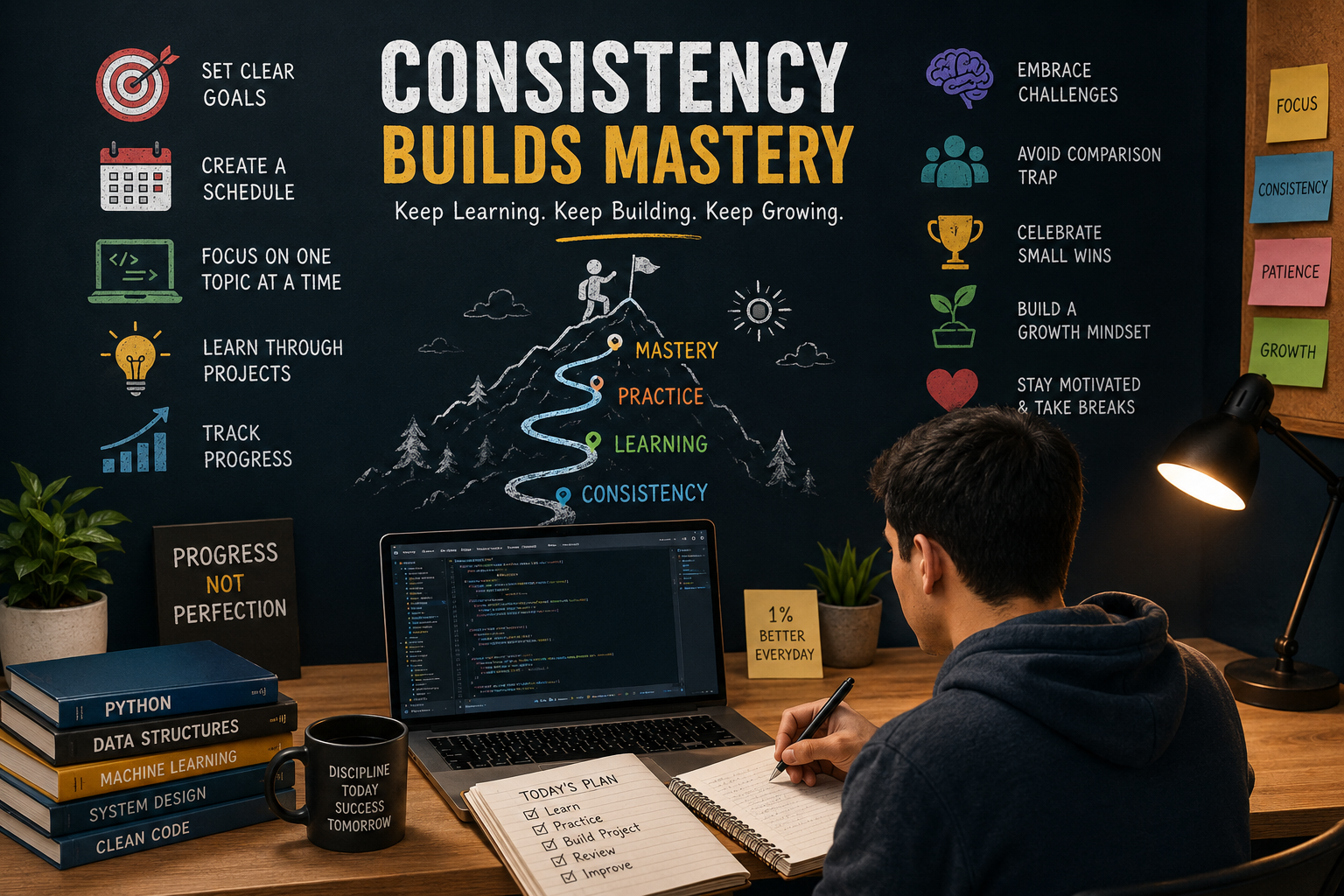
One of the biggest challenges in the technology field is not finding resources to learn from it's staying consistent long enough to actually learn something meaningful.
Every day, new technologies, frameworks, tools, and trends appear. As a Computer Science student, I often come across exciting topics that I want to explore. Whether it's artificial intelligence, data analytics, web development, cybersecurity, or cloud computing, there is always something new to learn.
In the beginning, I believed motivation was the key to success. Whenever I felt inspired, I would spend hours learning new concepts and watching tutorials. However, I soon discovered a problem: motivation comes and goes.
Some days I felt highly productive, while on other days I struggled to focus. If I depended entirely on motivation, my progress became inconsistent.
Over time, I realized that consistency is far more important than motivation. The students and professionals who continue improving are not necessarily the most talented; they are often the ones who keep showing up and learning regularly.
This article shares the strategies that help me stay consistent while learning new technologies.
Understanding That Learning Is a Long-Term Process
One mistake I made early in my learning journey was expecting fast results.
Whenever I started a new topic, I wanted to become proficient as quickly as possible. If progress felt slow, I would become frustrated.
Eventually, I learned that technology is a field that rewards patience.
Whether you are learning Python, SQL, React, Artificial Intelligence, or Data Analytics, meaningful progress takes time.
Instead of focusing on how much I still had to learn, I began focusing on improving a little each day.
This small shift in mindset made a significant difference.
Setting Clear Learning Goals
I have noticed that consistency becomes much easier when I know exactly what I am trying to achieve.
Without a goal, learning often becomes random and unfocused.
For example, instead of saying:
"I want to learn AI."
I create more specific goals such as:
* Complete an AI course.
* Build an AI-powered project.
* Learn machine learning fundamentals.
* Understand neural networks.
Specific goals provide direction and make progress easier to measure.
Whenever I finish one goal, I set the next one.
This creates a continuous learning cycle.
Focusing on One Major Topic at a Time
One challenge many students face is trying to learn everything simultaneously.
I experienced this myself.
At one point, I was attempting to learn:
* Web development
* Data analytics
* Artificial intelligence
* Cybersecurity
all at the same time.
While curiosity is valuable, spreading attention across too many areas often slows progress.
Now, I focus on one primary learning objective while maintaining awareness of other topics.
This allows me to build deeper knowledge instead of constantly switching between subjects.
Creating a Learning Schedule
Consistency becomes easier when learning becomes part of a routine.
Rather than waiting for the perfect moment, I try to allocate dedicated time for learning.
The exact schedule is less important than maintaining regularity.
Even small daily learning sessions can produce significant results over time.
What matters most is creating a habit that is sustainable.
A realistic schedule is always better than an ambitious plan that cannot be maintained.
Learning Through Projects
One of the most effective ways I stay engaged is by working on projects.
Projects transform learning from a theoretical activity into a practical experience.
Whenever I learn a new technology, I ask myself:
"What can I build with this?"
Projects provide:
* Motivation
* Real-world experience
* Problem-solving opportunities
* Visible progress
They also make learning more enjoyable because there is a tangible outcome.
Some of my most valuable lessons came from building projects rather than simply consuming tutorials.
Accepting That Confusion Is Normal
When learning new technologies, confusion is inevitable.
There have been many moments when concepts seemed overwhelming or difficult to understand.
Initially, I viewed confusion as a sign that I was struggling.
Today, I see it differently.
Confusion often indicates that learning is taking place.
New concepts challenge existing knowledge and require time to fully understand.
Whenever I encounter something difficult, I remind myself that understanding develops gradually.
The goal is not immediate mastery.
The goal is continuous improvement.
Avoiding the Comparison Trap
Technology communities are filled with talented individuals sharing impressive projects and achievements.
While these examples can be inspiring, they can also create unrealistic expectations.
There were times when I compared my progress to developers with years of experience.
This often led to unnecessary frustration.
Eventually, I realized that every person's journey is different.
The only comparison that truly matters is comparing my current skills to where I was previously.
Focusing on personal growth creates a healthier learning experience.
Tracking Progress
One of the most motivating habits I have developed is tracking progress.
When learning complex topics, improvement is often gradual and difficult to notice.
Keeping track of completed courses, projects, certifications, and skills provides evidence of growth.
Looking back at previous achievements reminds me how much progress has already been made.
This creates motivation to continue moving forward.
Progress tracking does not need to be complicated.
Even a simple list of completed milestones can be highly effective.
Taking Breaks When Necessary
Consistency does not mean working continuously without rest.
In fact, proper breaks often improve long-term productivity.
There have been occasions when I felt mentally exhausted after spending extended periods studying technical topics.
Taking short breaks helped me:
* Reduce stress
* Improve focus
* Prevent burnout
* Maintain motivation
Learning should be sustainable.
A balanced approach is more effective than constant overwork.
Celebrating Small Wins
Many learners focus only on major achievements.
For example:
* Completing a certification
* Landing an internship
* Building a large project
While these milestones are important, I have learned to appreciate smaller victories as well.
Examples include:
* Solving a difficult problem
* Understanding a challenging concept
* Completing a module
* Finishing a feature
These small successes create momentum and make the learning journey more enjoyable.
Building a Growth Mindset
One of the most valuable lessons I have learned is that skills can be developed through effort and practice.
When encountering difficult topics, it is easy to think:
"I am not good at this."
Instead, I try to think:
"I am not good at this yet."
The word "yet" changes everything.
It transforms challenges into opportunities for growth.
A growth mindset encourages persistence and continuous improvement.
Finding Personal Motivation
Everyone has different reasons for learning.
For me, technology represents opportunity.
Every skill I learn increases my ability to:
* Build projects
* Solve problems
* Explore new ideas
* Create value
* Advance my career
Whenever motivation decreases, I remind myself why I started.
Having a meaningful reason to learn makes consistency easier.
Lessons I Have Learned
Through my learning journey, several important lessons have become clear:
* Consistency beats intensity.
* Projects accelerate learning.
* Confusion is part of the process.
* Progress takes time.
* Small improvements compound over time.
* Learning never truly ends.
These principles continue to guide my approach to technology and personal development.
Final Thoughts
Staying consistent while learning new technologies is not always easy. There are moments of excitement, frustration, success, and uncertainty.
However, I have learned that long-term success is not determined by occasional bursts of motivation. It is determined by the ability to keep learning, even when progress feels slow.
Every course completed, every project built, and every problem solved contributes to growth.
Technology evolves rapidly, and there will always be something new to learn. Rather than viewing this as a challenge, I see it as an opportunity.
By focusing on consistency, setting clear goals, building projects, and maintaining a growth mindset, I continue moving forward one step at a time.
The journey is ongoing, but that is what makes it worthwhile. Every day presents another opportunity to learn, improve, and become a better version of myself.