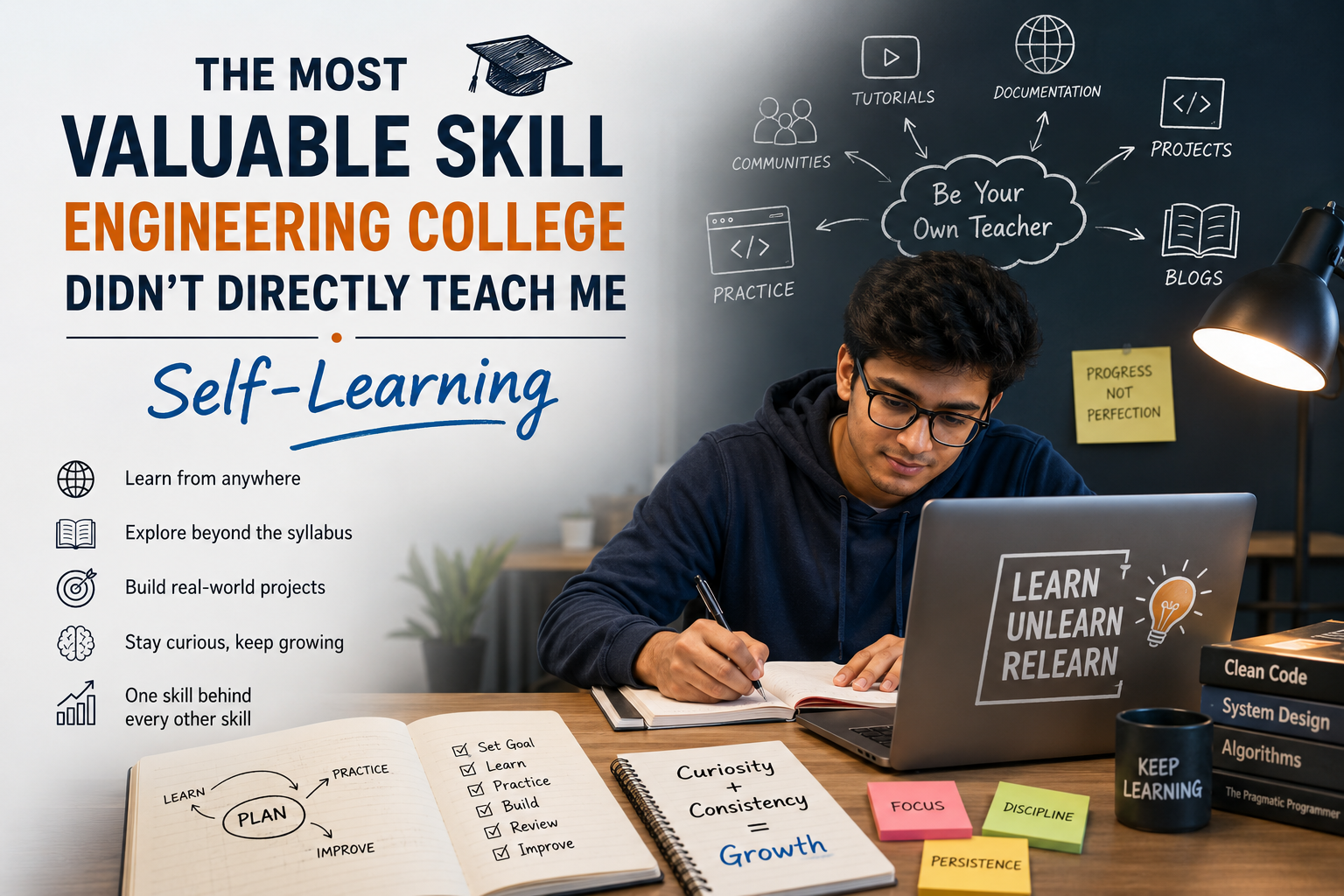
When people think about engineering college, they usually think about technical subjects.
Programming.
Databases.
Operating Systems.
Computer Networks.
Artificial Intelligence.
And while these subjects are undoubtedly important, there is one skill that has had a greater impact on my growth than any individual technical topic.
Interestingly, it wasn't taught as a dedicated subject.
There was no textbook for it.
No semester exam.
No assignment.
No lab practical.
Yet it became one of the most valuable skills I developed during my college journey.
That skill is self-learning.
What I Expected Before College
Before entering engineering college, I had a fairly simple understanding of education.
I believed success would come from attending lectures, completing assignments, studying for exams, and following the curriculum.
In school, that approach worked reasonably well.
Teachers guided us through almost everything.
The learning path was clearly defined.
The next step was usually obvious.
I assumed college would work similarly.
I was wrong.
The First Reality Check
One of the biggest surprises I experienced was realizing how much learning happens outside the classroom.
Technology evolves incredibly fast.
New frameworks appear.
New tools emerge.
Entire industries change within a few years.
No college curriculum can keep up with everything happening in the technology world.
I gradually realized that if I wanted to grow beyond the syllabus, I would have to learn independently.
At first, this felt intimidating.
There was no roadmap.
No instructor telling me exactly what to do next.
Just a huge amount of information and endless possibilities.
The Internet Became My Classroom
Once I accepted that self-learning was necessary, my approach to education changed completely.
I stopped seeing learning as something that only happened inside classrooms.
Instead, I started learning from:
* Documentation
* Online courses
* Technical blogs
* YouTube videos
* Developer communities
* Real-world projects
Suddenly, the classroom was no longer limited to a physical space.
Learning could happen anywhere.
And more importantly, it could happen at my own pace.
Why Self-Learning Matters More Than Ever
One thing I've noticed about technology is that knowledge has a short lifespan.
A tool that is popular today may become less relevant tomorrow.
Frameworks change.
Best practices evolve.
Industries adapt.
Because of this, the ability to learn independently becomes incredibly valuable.
Knowing a specific technology is useful.
Knowing how to learn new technologies is even more useful.
One skill has an expiration date.
The other continues creating value throughout your career.
The Difference Between Being Taught and Learning
This is something I didn't fully understand during my early college years.
Being taught and learning are not the same thing.
Someone can explain a concept perfectly.
But understanding still requires effort from the learner.
Real learning happens when:
* You ask questions.
* You explore deeper.
* You apply concepts.
* You make mistakes.
* You solve problems.
The responsibility eventually shifts from the teacher to the student.
Once I understood this, I became much more proactive in my learning journey.
Projects Taught Me More Than I Expected
One of the biggest contributors to my self-learning journey has been project development.
Projects create situations where answers aren't immediately available.
You encounter problems.
You research solutions.
You experiment.
You fail.
You try again.
This process naturally develops self-learning skills.
In many cases, the most valuable lessons from a project aren't technical.
They're the lessons about persistence, research, and problem-solving.
The Skill Behind Every Other Skill
Looking back, almost every technical skill I've developed started with self-learning.
Whether it was:
* Programming
* Data Analytics
* Web Development
* Artificial Intelligence
* SQL
* Dashboard Development
The process was always similar.
I became curious.
I started learning.
I applied the knowledge.
I improved through practice.
The technology changed.
The learning process remained the same.
That's when I realized self-learning isn't just another skill.
It's the skill behind every other skill.
Why Some Students Grow Faster Than Others
This is something I've observed repeatedly.
Students often have access to similar resources.
They attend the same classes.
Study similar subjects.
Use the same internet.
Yet some students grow much faster.
I don't think the difference is intelligence.
I think the difference is initiative.
The students who actively seek knowledge tend to improve faster than those who wait for knowledge to be delivered.
Self-learning creates momentum.
And momentum compounds over time.
The Freedom of Self-Learning
One aspect I particularly appreciate is the freedom it provides.
When you know how to learn independently, you're no longer restricted by formal education.
Interested in AI?
Start learning.
Curious about cybersecurity?
Start exploring.
Want to understand cloud computing?
Begin today.
The ability to learn independently removes many traditional barriers.
You no longer need permission to start growing.
The Challenges of Self-Learning
Of course, self-learning is not always easy.
Some challenges include:
Information Overload
There are countless resources available.
Choosing where to start can be difficult.
Lack of Structure
Without a clear roadmap, it's easy to feel lost.
Consistency
Motivation fluctuates.
Maintaining progress requires discipline.
Self-Doubt
There are moments when progress feels slow.
Moments when confusion creates frustration.
I've experienced all of these challenges.
But overcoming them has been part of the learning process itself.
What Self-Learning Has Given Me
Beyond technical knowledge, self-learning has helped me develop:
* Confidence
* Curiosity
* Problem-solving ability
* Adaptability
* Independence
These qualities influence much more than programming.
They influence how I approach challenges in general.
The more I learn independently, the more comfortable I become with uncertainty.
And in a rapidly changing world, that's an incredibly valuable ability.
Advice for Students
If I could give one piece of advice to students entering engineering college, it would be this:
Don't limit your education to the syllabus.
Use the curriculum as a foundation.
Then build upon it.
Explore topics that genuinely interest you.
Build projects.
Read documentation.
Take courses.
Experiment.
Stay curious.
The students who continue learning outside the classroom often create the biggest opportunities for themselves.
Final Thoughts
Engineering college has taught me many valuable things.
It introduced me to technical concepts, problem-solving methods, and foundational knowledge that continue to help me today.
But the most valuable skill I gained wasn't listed in any subject syllabus.
It was the ability to teach myself.
Because technologies will change.
Industries will evolve.
New opportunities will emerge.
And when those changes happen, the ability to learn independently will remain valuable.
Looking back, self-learning has influenced my growth more than any individual technology I've studied.
And I believe it will continue to be one of the most important skills throughout my career.
In many ways, engineering college taught me subjects.
But self-learning taught me how to keep growing long after the classroom ends.