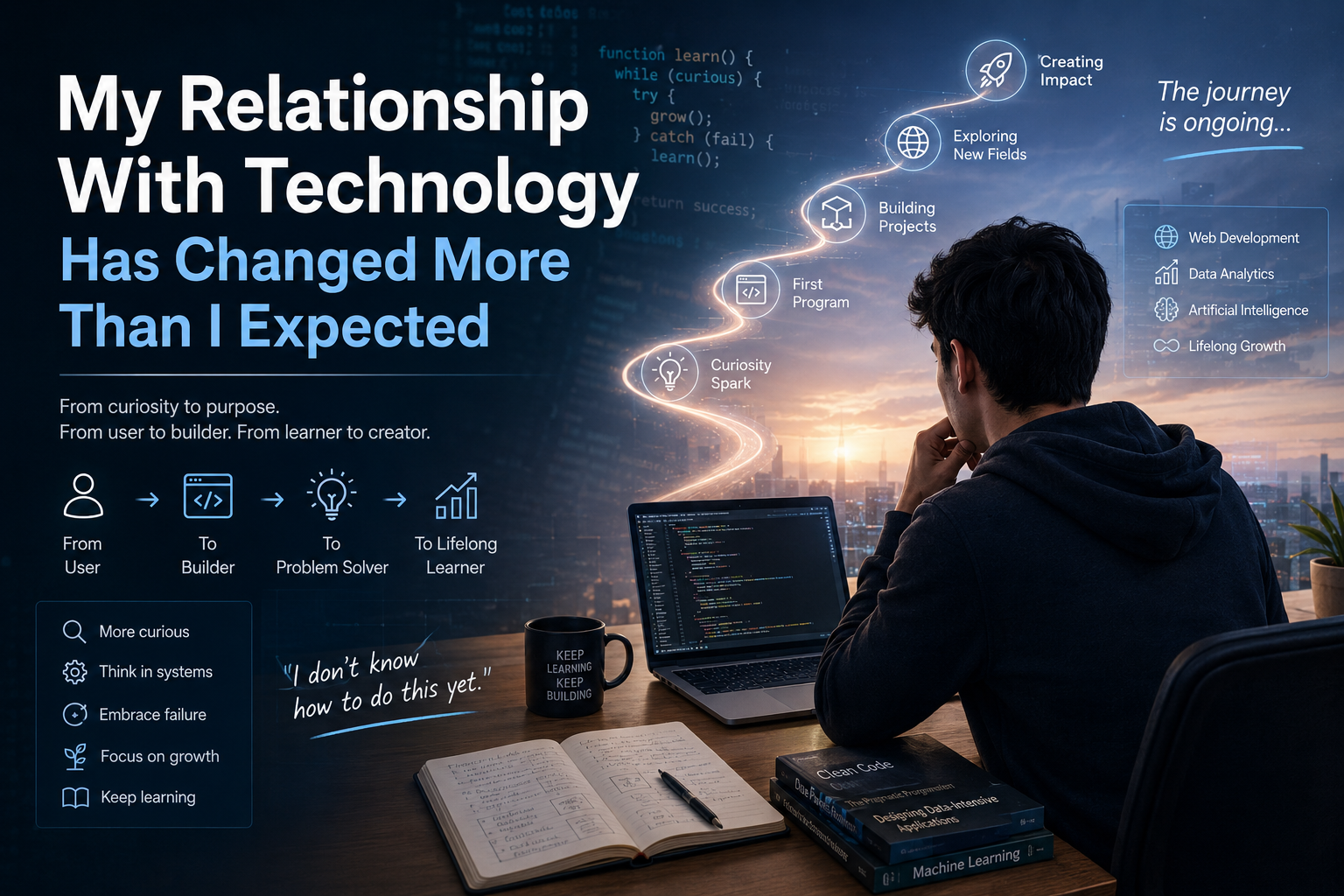
If someone had asked me a few years ago what technology meant to me, my answer would have been simple.
Technology was something I used.
My phone.
My laptop.
My favorite apps.
The websites I visited every day.
I appreciated technology because it made life easier, but I never spent much time thinking about how it worked behind the scenes.
Today, my relationship with technology is completely different.
The more I learned about programming, software development, artificial intelligence, and data analytics, the more my perspective changed.
Technology stopped being something I simply consumed.
It became something I wanted to understand.
Then it became something I wanted to create.
And eventually, it became something that changed the way I think.
From User to Builder
One of the biggest mindset shifts happened when I wrote my first few programs.
Before that, applications felt almost magical.
You open an app.
Press a button.
Something happens.
Everything feels seamless.
As a user, you rarely think about the thousands of decisions, systems, and lines of code operating behind the scenes.
Programming changed that.
Suddenly, I started noticing things I had never paid attention to before.
Every website became a collection of design decisions.
Every application became a collection of technical solutions.
Every feature became a problem someone had solved.
Technology became far more interesting once I understood that real people built it.
I Started Seeing Problems Differently
Before learning technology, I often looked at problems and immediately focused on the difficulty.
Now I find myself looking for systems.
Patterns.
Processes.
Possible solutions.
Programming trains you to think differently.
Whenever something doesn't work, your first instinct becomes:
"Why?"
And then:
"How can it be fixed?"
This habit slowly extends beyond coding.
I've noticed myself applying the same thinking to everyday situations.
Breaking problems into smaller parts.
Looking for root causes.
Testing possible solutions.
Technology didn't just teach me programming.
It taught me a different way of approaching challenges.
Technology Made Me More Curious
One unexpected effect of learning technology is that curiosity became stronger.
The more I learned, the more questions I had.
Questions like:
* How do recommendation systems work?
* How does Google process billions of searches?
* How do AI models generate responses?
* How does a payment system handle millions of transactions?
Every answer seemed to create five new questions.
Instead of reducing curiosity, learning technology expanded it.
And honestly, I think that's one of the reasons I enjoy this field so much.
There is always something new to discover.
I Stopped Looking for Shortcuts
This lesson took time.
Like many students, I occasionally searched for the fastest way to learn something.
The quickest course.
The easiest roadmap.
The perfect tutorial.
Eventually, technology taught me a reality that applies almost everywhere:
There are very few shortcuts.
Projects take time.
Skills take time.
Understanding takes time.
Growth takes time.
The sooner I accepted this, the more enjoyable learning became.
Instead of chasing speed, I started focusing on consistency.
And consistency produced better results.
Failure Feels Different Now
Before learning programming, failure often felt final.
If something didn't work, it felt discouraging.
Technology changed that perspective.
When you build software, things fail constantly.
Features break.
Deployments fail.
Bugs appear.
Errors happen.
At first, this feels frustrating.
Eventually, it becomes normal.
You learn that failure is not the opposite of progress.
Failure is part of progress.
Some of the most valuable lessons I've learned came from projects that didn't work the first time.
Or the second time.
Or even the third time.
Technology made me more comfortable with failure because it taught me that failure is usually temporary.
The Internet Became More Than Entertainment
Growing up, most of my internet usage was focused on entertainment.
Videos.
Social media.
Games.
Content consumption.
As I became more involved in technology, the internet transformed into something else.
A classroom.
A library.
A workspace.
A community.
Today, some of the most important things I've learned came from resources freely available online.
The internet became one of the most powerful educational tools I've ever used.
That realization changed how I spend my time online.
I Became More Aware of How Much I Don't Know
This might sound strange, but one of the most valuable things technology taught me was humility.
The more I learn, the more I realize how much I still don't understand.
Every topic opens the door to dozens of others.
Artificial Intelligence leads to Machine Learning.
Machine Learning leads to Statistics.
Statistics leads to Mathematics.
Mathematics leads to even deeper concepts.
The learning never really ends.
At first, this felt overwhelming.
Now I find it exciting.
It means there will always be opportunities to grow.
Technology Changed My Career Goals
When I first entered engineering, my understanding of career paths was limited.
I knew technology was important.
I knew software jobs existed.
But I didn't fully understand the possibilities.
As I explored different fields, my interests evolved.
Web development introduced me to building products.
Data analytics introduced me to insights.
Artificial intelligence introduced me to innovation.
Every new experience expanded my view of what was possible.
Technology didn't just give me skills.
It helped me discover what kind of work I enjoy.
The Most Important Change
Out of everything technology has changed, one thing stands above the rest.
It changed my confidence.
Not confidence in the sense of knowing everything.
The opposite, actually.
Confidence that I can learn things I don't know.
When I encounter something unfamiliar today, my reaction is very different from a few years ago.
Instead of thinking:
"I don't know how to do this."
I think:
"I don't know how to do this yet."
That small difference in mindset has been incredibly powerful.
Looking Ahead
Technology will continue changing.
New tools will appear.
New industries will emerge.
New opportunities will be created.
I know the technologies I'm learning today may look very different in a few years.
But that's not what matters most.
The most valuable thing technology has given me isn't a specific tool or programming language.
It's the mindset of continuous learning.
The willingness to adapt.
The curiosity to explore.
The confidence to start even when I don't have all the answers.
Final Thoughts
My relationship with technology has changed far more than I ever expected.
What started as simple curiosity gradually became a passion for learning, building, and solving problems.
Technology has influenced how I think, how I learn, how I approach challenges, and how I view the future.
And perhaps the most surprising part is that I still feel like I'm only getting started.
There is so much left to learn.
So many ideas left to explore.
So many problems left to solve.
For me, that's what makes technology exciting.
Not because it has all the answers.
But because it constantly encourages you to keep searching for them.